Growth buyout Private Equity: Key Features and Benefits
Published on
27
Amended on
20
Growth buyout of the natural evolution of private equity. Value creation depends first and foremost on the quality of the business plan and the ability to execute it operationally.
This article has been automatically translated. Please excuse any inaccuracies or translation errors.
Dieser Artikel wurde automatisch übersetzt. Bitte entschuldigen Sie etwaige Ungenauigkeiten oder Übersetzungsfehler.
This article has been automatically translated. We apologize per inaccuracies or translation errors.
Definition of buyout growth buyout general framework
A growth buyout is a private equity transaction in which a fund acquires a significant, often controlling, stake in a company that already has a proven business model.
The transaction generally involves the use of debt, but only to a moderate extent, consistent with continuing to make strategic investments and maintaining the company’s financial strength.
It should be noted that, like any private equity transaction, a growth buyout a long-term investment and involves structural illiquidity. The capital invested is not available in the short term, and the value of the holdings may increase or decrease depending on the company’s performance and market conditions.
Growth buyout LBO : A Difference in Risk Profiles
While a growth buyout certain characteristics with an LBO—particularly with regard to taking control and corporate governance—it differs from an LBO in terms of the nature of the risks assumed by the investor.
In a LBO leveraged LBO , sensitivity to financing terms and cash flow generation is particularly high. A deterioration in the economic environment can quickly affect the company’s ability to meet its financial obligations.
In a growth buyout, the more moderate level of financial leverage generally helps reduce this risk of balance sheet strain. On the other hand, the investor is more exposed to operational and strategic risks related to the execution of the growth plan.
The success of the investment therefore depends heavily on the ability of management and the Fund manager effectively steer the company’s transformation.
An approach that falls between buyout growth equity
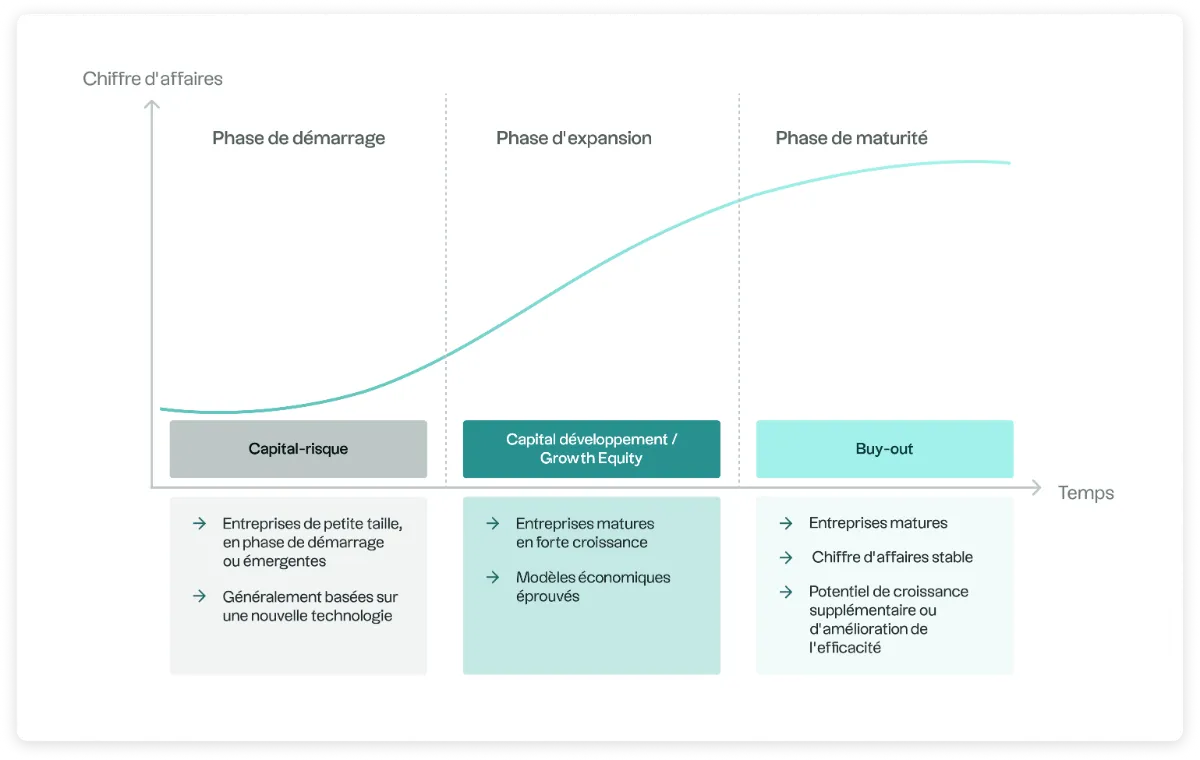
From an investor's perspective, a growth buyout be viewed as a strategy that falls between a buyout growth equity. Unlike growth equity, which often involves a minority stake, it allows for more direct involvement in corporate governance and strategic decision-making.
This increased involvement is intended to better manage execution risks, without, however, eliminating the uncertainties inherent in growth phases.
It is important to remember that, even in this context, no growth trajectory is guaranteed.
The assumptions made at the time of the investment may be called into question by unfavorable developments in the sector , the competitive landscape, or the macroeconomy.
Growth equity involvement in the life cycle of a company
Why Incorporate a Growth buyout a Private Equity Strategy?
For a professional or institutional investor, a growth buyout is primarily part of a strategy to build a portfolio and diversify sources of value creation in private equity.
This strategy provides exposure to unlisted companies that are already profitable, while capitalizing on growth momentum driven by identified operational levers.
It thus differs from approaches that rely primarily on financial leverage or on technological ventures that are still in their infancy.
From an economic perspective, a growth buyout a middle ground between a buyout and growth equity.
It combines access to business growth with strengthened governance mechanisms designed to guide strategic decisions and mitigate execution risks.
For the Fund manager, this ability to take action is a central component of the investment thesis, particularly during periods of transformation or acceleration when organizational and operational challenges are critical.
It is important to note, however, that private equity remains a risky asset class, and that growth buyout to this rule.
Investors are exposed to the risk of capital loss, structural illiquidity of investments, and increased portfolio concentration in a limited number of holdings.
Furthermore, performance is closely tied to companies’ ability to execute their growth plans in an economic environment that can at times be uncertain, which can lead to significant discrepancies between anticipated trajectories and actual results.
In this context, a growth buyout be viewed as one tool among many within an overall private equity allocation. Its inclusion must be consistent with the investor’s investment horizon, risk tolerance, and diversification objectives.
In this sense, it is part of a long-term approach based on the complementarity of strategies rather than on the search for a single driver of performance.
The investment strategy of Altaroc portfolios
As a fund of funds specializing in private equity, Altaroc rigorously Altaroc targeted investment strategies based on an in-depth analysis of their risk profile, value creation mechanisms, and consistency within a long-term allocation. The preferred strategies are in sectors and geographical areas with structural growth dynamics, while taking into account the specific risks inherent in unlisted markets.
This approach aims to build diversified portfolios, exposed to different private equity strategies, within a disciplined investment framework and a long-term investment horizon.
However, private equity investments involve risks, including the risk of capital loss and illiquidity of investments, and there is no guarantee of performance.
This type of transaction does indeed involve complex transformation phases that require a detailed understanding of the strategic, operational, and financial challenges specific to growing companies.
The Fund manager primary role Fund manager to establish a governance structure suited to the company’s growth. This involves setting upeffective decision-making bodies , clarifying the roles of shareholders and management, and implementing management processes that enable rigorous performance monitoring.
This organizational structure is essential for ensuring the successful implementation of the growth plan and making strategic decisions in an often uncertain environment.
Fund manager expertise Fund manager also evident in his ability to prioritize and sequence the drivers of value creation.
In a growth buyout, the goal is not merely to finance growth, butto support strategic decisions—whether they involve organic investments, external growth, key hires, or organizational transformations.
The Fund manager also Fund manager a central role as a strategic partner to management. He or she provides an outside perspective, discipline in execution, and insights gained from similar transactions.
This contribution aims to enhance the quality of decision-making and support leadership teams during phases when the complexity of the business is growing faster than its internal structures.
It should be noted, however, that despite this level of expertise and commitment, the Fund manager involvementdoes not guarantee success.
Growth buyout vulnerable to economic, industry-specific, and operational risks.
Certain assumptions may not materialize as anticipated, which could affect the investment’s performance and valuation, despite active and structured support.
Words from entrepreneurs
Read our interview with Frédéric Trinel, CEO of EcoVadis, who discusses the contribution of General Atlantic, a fund specializing in growth strategies, and the value of its support during the various phases of the company's development.
From an investor’s perspective, a growth buyout primarily exposes the investor to the risk associated with executing the growth plan.
The success of the investment depends heavily on the company’s ability to implement the identified strategic initiatives, whether they involve organic growth, international expansion, or acquisitions.
Any delay, operational deviation, or integration challenge can affect the value creation trajectory.
This strategy also carries a risk of dependence on management, which is particularly pronounced during growth phases. The company’s performance often relies on a tight-knit leadership team, whose stability, experience, and ability to drive change are critical. The loss of key talent or a mismatch between management’s skills and the project’s ambitions can weaken the company’s position.
Furthermore, growth buyout immune to economic and sector-specific cycles. An economic downturn, unfavorable changes in the regulatory environment, or increased competition can weigh on thecompany’s anticipated growth and profitability. Even with moderate leverage, these exogenous factors can have a significant impact on the value of the portfolio companies.
Finally, it should be noted that the valuation of unlisted companies is based on estimation methods that involve a degree of assessment and judgment. These valuations may change over time depending on actual performance, market outlook, and exit conditions, and in no way constitute a guarantee of future value.
All of these risks call for a prudent and disciplined approach, based on rigorous selection of strategies and teams, appropriate diversification of investments, and ongoing monitoring of holdings over time. Despite these precautions, the risk of capital loss cannot be ruled out.
A structured growth strategy, with no performance guarantees
A growth buyout is a structured approach to private equity that aims to support the growth of privately held companies with strong fundamentals, while maintaining financial discipline and rigorous governance.
By combining exposure to growth with the management of operational and financial risks, this strategy is designed to generate gradual and sustainable value.
For a management firm specializing in private equity such as Altaroc, growth buyout of a long-term vision for private equity, based on the rigorous selection of strategies and management teams, as well as a carefully considered allocation across different investment approaches. The goal is not to pursue short-term performance, but to build coherent portfolios exposed to identified value drivers, within a disciplined management framework.
It should be noted, however, that private equity investments involve risks, including the risk of capital loss, structural illiquidity, and uncertainties related to the performance of companies and markets. Past or projected performance is not indicative of future results. Growth buyout therefore be viewed as part of an overall investment strategy tailored to each investor’s risk profile, objectives, and investment horizon.
FAQ – Growth buyout
What is a growth buyout private equity?
A growth buyout a private equity transaction in which an investor acquires a significant, often controlling, stake in an already profitable company in orderto support its growth.
This strategy combines structured governance with ameasured use of debt, with value creation relying primarily on the company’s operational growth.
What is the difference between a growth buyout a LBO ?
The main difference between a growth buyout an LBO in the approach to value creation. In a LBO , financial leverage plays a central role.
In a growth buyout, leverage is more moderate, and performance depends more on business growth,strategic execution, andimprovements in the company’sfundamentals.
How buyout a growth buyout differ from growth equity?
Growth equity typically involves minority equity investments, with limited involvement in corporate governance. Growth buyout , on the other hand, buyout the investor buyout play a more active role—particularly in corporate governance and strategic management—in order tomanage the risks associated with the growth phase.
What types of companies are growth buyout intended for buyout
Growth buyout primarily buyout at privately held companies with a proven business model, existing profitability, and significant growth potential.
It is particularly well-suited for small and medium-sized businesses and mid-sized companies looking to scale up while maintaining a balanced financial structure.
What are the main risks of a growth buyout
Like any private equity investment, a growth buyout risks, including the risk of capital loss, illiquidity of the investments, and risks related to the execution of the growth plan.
Reliance on management andexposure to economic cycles can also affect investment performance.
buyout a growth buyout a guarantee of performance?
No. A growth buyout does buyout include any performance guarantees.
The valuations of unlisted companies can rise or fall, depending on the company's performance and market conditions.
Past or projected performance is not indicative of future results.
Why include growth buyout a private equity portfolio?
Growth buyout be a component of a private equity portfolio, providing exposure to the growth of unlisted companies while relying on governance mechanisms designed to manage risk.
However, it must be part of an overall strategy that is consistent with the investor’s risk profile and investment horizon.
Salma Moumen is Chief Project Officer at Altaroc. A graduate of TBS Education with a specialization in Banking & Corporate Finance, she began her career by assisting fintech companies with their fundraising efforts before focusing on the digital transformation of financial sector players, at the intersection of business and technology challenges. Through her articles, she offers an informative, well-researched, and objective analysis of private markets, their mechanisms, and the risks associated with them.
In accordance with applicable regulations, we ask that you complete your profile. This step is required to access the content and services offered on our websites.
Please fill out your profile to access the site
country of tax residence
Select
choosenCountry
Preferred language
Select
choosenLang
YOUR INVESTOR PROFILE
Financial intermediary or professional investor
Financial advisors, wealth managers, private bankers, or any other investment service providers.
Qualified Investor or Altaroc Investor
Experienced investor or Altaroc investor
Private investors who have already invested with Altaroc or who have a minimum investment capacity of €100,000.
Private investors who have previously invested in Altaroc who have a minimum investment capacity of 200,000 euros.
Non-professional (retail) investor
Individual investors with an investment capacity below €100,000.
Retail investors with an investment capacity of less than 200,000 euros.
Institutional investor
Pension funds, retirement schemes, asset management companies, and single-family offices.
Important information
choosenTerms
choosenTermsValue
Select your language and investor profile to continue
Select your investor profile to continue
Scroll down to accept General Terms and Conditions












_5_11zon.webp)

_1_11zon.webp)