Investment funds and mutual funds play an important role in asset management and wealth management.
Investment mechanisms and specific features of unlisted companies
The unlisted market is an investment universe mobilized by certain investment funds and mutual funds, particularly through private equity or venture capital structures. To understand the issues at stake, it is useful to analyze the structuring, horizon, and risk profiles specific to these funds.
This article has been automatically translated. Please excuse any inaccuracies or translation errors.
Dieser Artikel wurde automatisch übersetzt. Bitte entschuldigen Sie etwaige Ungenauigkeiten oder Übersetzungsfehler.
This article has been automatically translated. We apologize per inaccuracies or translation errors.
Investment funds and mutual funds: essential definitions
What is an investment fund?
An investment fund is a collective investment vehicle that pools capital from multiple investors in order to manage it according to a predefined strategy. This strategy is set forth in the fund’s regulatory documentation, including the prospectus and the fund rules.
The concept of an investment fund is broad. It encompasses both funds invested in liquid financial markets and funds exposed to unlisted or illiquid assets, such as direct real estate or private equity.
An investment fund does not aim to provide a guaranteed return. It is a structured framework for collective investment, subject to operating and oversight rules, but exposed to risks associated with the markets and the underlying assets.
What is an investment fund?
The term “investment fund” refers more specifically to collective investment vehicles governed by specific prudential rules and intended for categories of investors defined by regulation.
In the European context, investment funds most often take the form ofUCITS oralternative investment funds. They are subject to strict requirements regarding diversification, liquidity, transparency, and investor disclosure.
The investment fund therefore operates within a standardized regulatory framework, although this does not eliminate the financial or asset-related risks associated with the investment.
How does an investment fund work?
Important information
This content is provided for informational purposes only. It does not constitute a recommendation, investment advice, or solicitation. All investments involve risk, including the risk of capital loss.
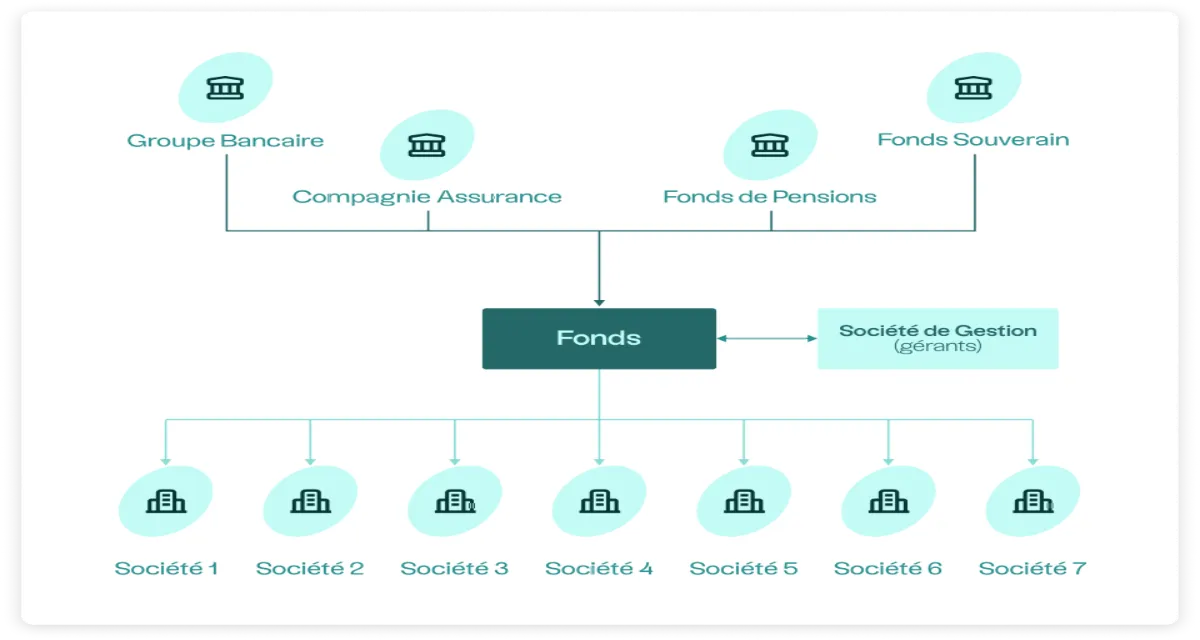
Capital raising and pooling
An investment fund raises capital from multiple investors. This capital is pooled within a single investment vehicle. Each investor holds units or shares representing a fraction of the fund.
Depending on the nature of the fund, subscriptions and redemptions may be frequent or, conversely, limited in time. Some funds provide for commitments that are called in gradually. These mechanisms can result in liquidity constraints.
Implementation of the management strategy
The management company implements the strategy outlined in the regulatory documentation. It selects assets, makes investment decisions, and adjusts the asset allocation based on market conditions and the fund’s constraints.
This management approach is based on formalized processes, including investment committees, risk limits, and internal controls. It does not eliminate market, credit, or liquidity risks.
Governance and regulatory framework
The operation of a fund relies on several key players. The custodian is responsible forsafekeeping the assets and overseeing certain transactions. The auditors certify the financial statements. The regulatory authorities ensure compliance with regulations.
These measures are intended to enhance transparency and investor protection, but do not constitute a guarantee against losses or volatility.
Illustrative Diagram of How a Private Equity Fund Works
Investment funds and mutual funds: what are the differences?
Scope and use of terms
An investment fund is a general term. It refersto all collective investment vehicles, whether open-end or closed-end, liquid or illiquid, accessible to the general public or reserved for professional investors.
The term “investment fund” refers more specifically to regulated entities designed to be marketed to specific categories of investors, with specific requirements regarding disclosure and operations.
Legal structure
Investment funds are generally structured as UCITS or alternative investment funds. Investment funds, in the broad sense, also include private or specialized structures, which are sometimes restricted to a limited number of investors.
Assets, risk, and liquidity
Investment funds may be exposed to a wide variety of assets, including illiquid assets. Mutual funds are often subject to additional diversification or liquidity constraints.
The level of risk depends primarily on the strategy and assets held, not on the terminology used.
The main types of funds in 2026
Equity and bond funds
These funds invest primarily in publicly traded securities. Their value may fluctuate significantly depending on financial markets, interest rates, and economic conditions.
Diversified funds
Diversified funds combine multiple asset classes within a single portfolio. This approach aims to spread exposure, without eliminating the risk of capital loss.
Real estate funds
Real estate funds offer indirect exposure to real estate, most often commercial real estate. They involve specific risks related to asset valuation, liquidity, and real estate market conditions.
Private equity fund
Private equity funds invest in unlisted companies. They have a long-term investment horizon and offer limited liquidity. The risk of capital loss is high.
Private equity: key facts
Private equity refers to an activity that involves investing in unlisted companies, generally over the long term. Understanding how it works allows you to grasp its objectives, different strategies, and the risks associated with this type of investment.
These funds incorporate environmental, social, or governance criteria into their investment processes. Approaches vary by fund and do not guarantee specific results or measurable impact.
How should you approach investing in a fund?
The information presented below is generic and provided for informational purposes only. It does not constitute investment advice and does not take into account the personal circumstances of readers.
Key elements analyzed
Investors generally examine the fund’s strategy,the management company’s organization, liquidity constraints, the fee structure, governance, and the quality of the available information .
This analysis is not a substitute for an evaluation conducted by a licensed professional.
Horizon liquidity
The investment horizon must be consistent with the nature of the underlying assets. Some funds involve a prolonged lock-up period, with no option for early redemption.
Diversification
Diversification across different asset classes or strategies can help limit certain concentrations of risk. It does not eliminate the possibility of losses.
FAQ
What are the main risks associated with investment funds?
The main risks associated with investment funds are:
Market risk: The value of assets held by a fund may rise or fall depending on economic, financial, or geopolitical conditions.
Illiquidity risk: Some funds do not allow for the rapid redemption of shares. Investors may be exposed to prolonged unavailability of their capital.
Dispersion of results: Funds with similar strategies may show very different results depending on the quality of management and market conditions.
The Importance of Fund manager The Fund manager organization , processes, and discipline Fund manager how the strategy is implemented. They do not guarantee performance.
What is the difference between an investment fund and a mutual fund?
An investment fund is a generic term that refers to any collective investment vehicle, regardless of its legal structure, level of liquidity, or target audience.
The investment fund refers more specifically to regulated vehicles, such as UCITS or alternative investment funds, designed to be distributed to identified categories of investors.
Why are these two terms often confused?
In everyday language, the terms investment fund and mutual fund are often used interchangeably. This confusion stems from the fact that many mutual funds are also, legally and economically, investment funds in the broad sense.
Is an investment fund a financial product?
An investment fund is not a product in the commercial sense of the term, but rather a collective investment vehicle. It is a legal and financial structure that allows for the holding of a portfolio of assets managed according to rules defined in its regulatory documentation.
How is a fund regulated?
A fund is governed by a set of rules covering its governance, asset preservation, investor information, and internal controls.
Several parties are involved, including the management company, the custodian, the auditors, and the supervisory authorities.
Do all funds operate in the same manner?
No. How a fund operates depends on its strategy, the nature of the assets it holds, its level of liquidity, and its regulatory framework. A fund that invests in listed markets does not operate in the same way as a fund that invests in unlisted assets.
Why do some funds impose a long investment horizon?
Some funds invest in assets that cannot be sold quickly, such as private equity or certain real estate assets.
The investment horizon is therefore linked to the time needed to invest, manage, and dispose of these assets under conditions compatible with the fund's strategy.
Where can I find detailed information about a fund?
Detailed information can be found in the fund's regulatory documentation, including the prospectus, key information document, and periodic reports. These documents describe how the fund operates, its strategy, risks, and practical arrangements.
Does this content constitute advice or promotional communication?
No. This content is provided for informational and educational purposes only. It does not constitute investment advice, personalized recommendations, or promotional communications. Any investment decision must be made based on each investor's individual circumstances.
Understand thoroughly before making any investment decision
Investment funds and mutual funds are key tools in asset management. They provide collective access to different asset classes within a regulated and supervised framework.
However, they involve significant risks, including the risk of capital loss, potential volatility, and, for certain vehicles, marked illiquidity.
This content is provided for informational purposes only. It does not constitute investment advice, personalized recommendations, or promotional communications. Any investment decision should be based on an individual analysis conducted with a licensed professional.
Investment mechanisms and specific features of unlisted companies
The unlisted market is an investment universe mobilized by certain investment funds and mutual funds, particularly through private equity or venture capital structures. To understand the issues at stake, it is useful to analyze the structuring, horizon, and risk profiles specific to these funds.
Salma Moumen is Chief Project Officer at Altaroc. A graduate of TBS Education with a specialization in Banking & Corporate Finance, she began her career by assisting fintech companies with their fundraising efforts before focusing on the digital transformation of financial sector players, at the intersection of business and technology challenges. Through her articles, she offers an informative, well-researched, and objective analysis of private markets, their mechanisms, and the risks associated with them.
In accordance with applicable regulations, we ask that you complete your profile. This step is required to access the content and services offered on our websites.
Please fill out your profile to access the site
country of tax residence
Select
choosenCountry
Preferred language
Select
choosenLang
YOUR INVESTOR PROFILE
Financial intermediary or professional investor
Financial advisors, wealth managers, private bankers, or any other investment service providers.
Qualified Investor or Altaroc Investor
Experienced investor or Altaroc investor
Private investors who have already invested with Altaroc or who have a minimum investment capacity of €100,000.
Private investors who have previously invested in Altaroc who have a minimum investment capacity of 200,000 euros.
Non-professional (retail) investor
Individual investors with an investment capacity below €100,000.
Retail investors with an investment capacity of less than 200,000 euros.
Institutional investor
Pension funds, retirement schemes, asset management companies, and single-family offices.
Important information
choosenTerms
choosenTermsValue
Select your language and investor profile to continue
Select your investor profile to continue
Scroll down to accept General Terms and Conditions













_5_11zon.webp)

_1_11zon.webp)