The J curve is one of the most frequently used concepts to describe the performance dynamics of a private equity fund.
Private Equity: Everything you need to know about private equity
Private equity is a key asset class in supporting the growth of unlisted companies. By providing long-term capital and strategic support, private equity contributes to the development, transformation, and value creation of SMEs and mid-cap companies. Understanding its mechanisms, performance, and risks is essential to assessing its role in long-term asset allocation.
This article has been automatically translated. Please excuse any inaccuracies or translation errors.
Dieser Artikel wurde automatisch übersetzt. Bitte entschuldigen Sie etwaige Ungenauigkeiten oder Übersetzungsfehler.
This article has been automatically translated. We apologize per inaccuracies or translation errors.
Understanding the concept of the J-curve
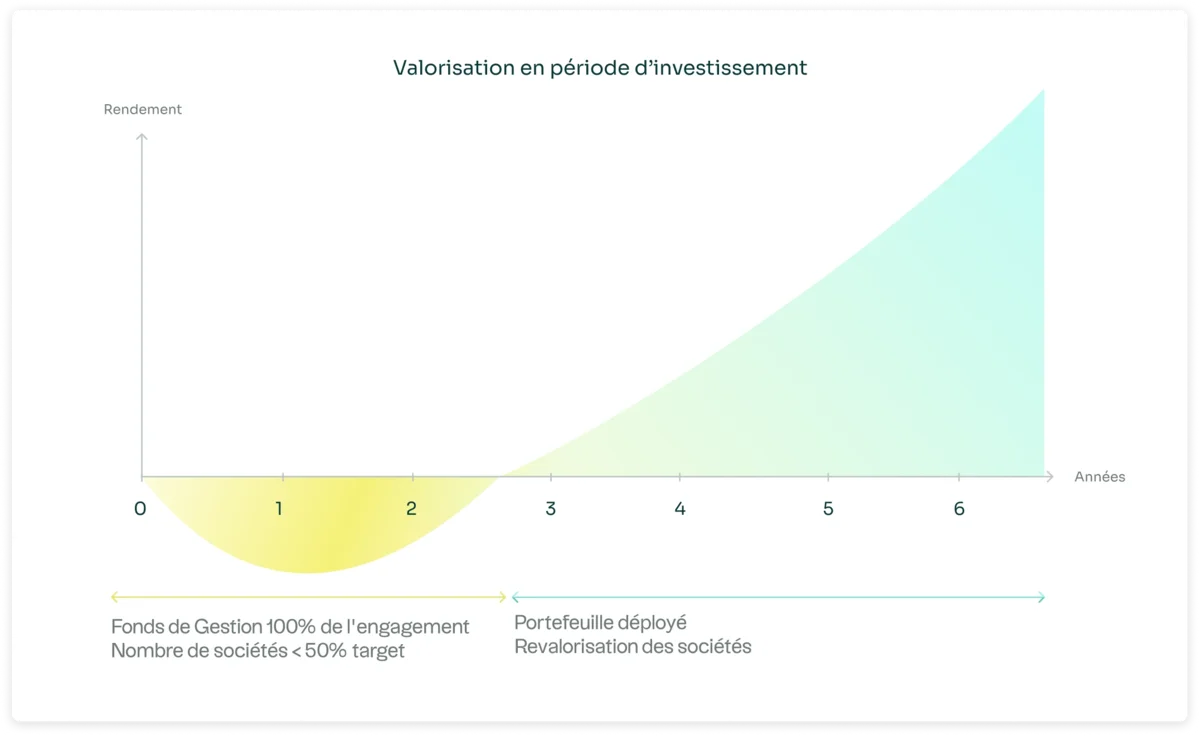
The J-curve refers to the typical pattern of a private equity fund’s cumulative performance over its lifetime. In the early years, the fund’s net asset value and cash flows primarily reflect capital outflows.
Cash outflows are related to capital calls and fees, while the underlying assets have not yet generated any distributions.
Gradually, the trajectory shifts as portfolio companies grow, their valuations change, and the first liquidity transactions are completed.
This perception is inextricably linked to the very nature of private equity.
Unlike listed assets, whose valuations are continuous and determined by the market, unlisted assets are valued on a periodic basis. Their valuations are based on conservative assumptions and operational data observed over time.
First, the commitments made by investors during the fundraising round are not invested immediately. The capital is called down gradually, as opportunities are identified by the management company, which results in cash outflows spread out over time.
At the same time, fund management fees begin to apply from the early years, regardless of the pace at which value is created by the investments.
This temporal asymmetry between immediate costs and deferred benefits contributes to the initial negative phase of the curve.
Finally, value creation itself is inherently delayed. Operational transformation plans, growth or consolidation strategies, and governance improvements take time to translate into value or liquidity. This time lag lies at the heart of the economic rationale behind private equity.
A phenomenon specific to illiquid assets
The J-curve is primarily observed in illiquid asset classes, foremost among which is private equity.
Unlike public markets, where value is determined continuously by the interplay of supply and demand, private equity funds rely on periodic internal valuations and one-time liquidity events.
Performance, therefore, does not materialize in a linear fashion. It results from a series of steps—sometimes lengthy ones—during which economic value increases without necessarily being immediately reflected in the published figures.
J-curve and fees in private equity
Private equity is a key asset class in supporting the growth of unlisted companies. By providing long-term capital and strategic support, private equity contributes to the development, transformation, and value creation of SMEs and mid-cap companies. Understanding its mechanisms, performance, and risks is essential to assessing its role in long-term asset allocation.
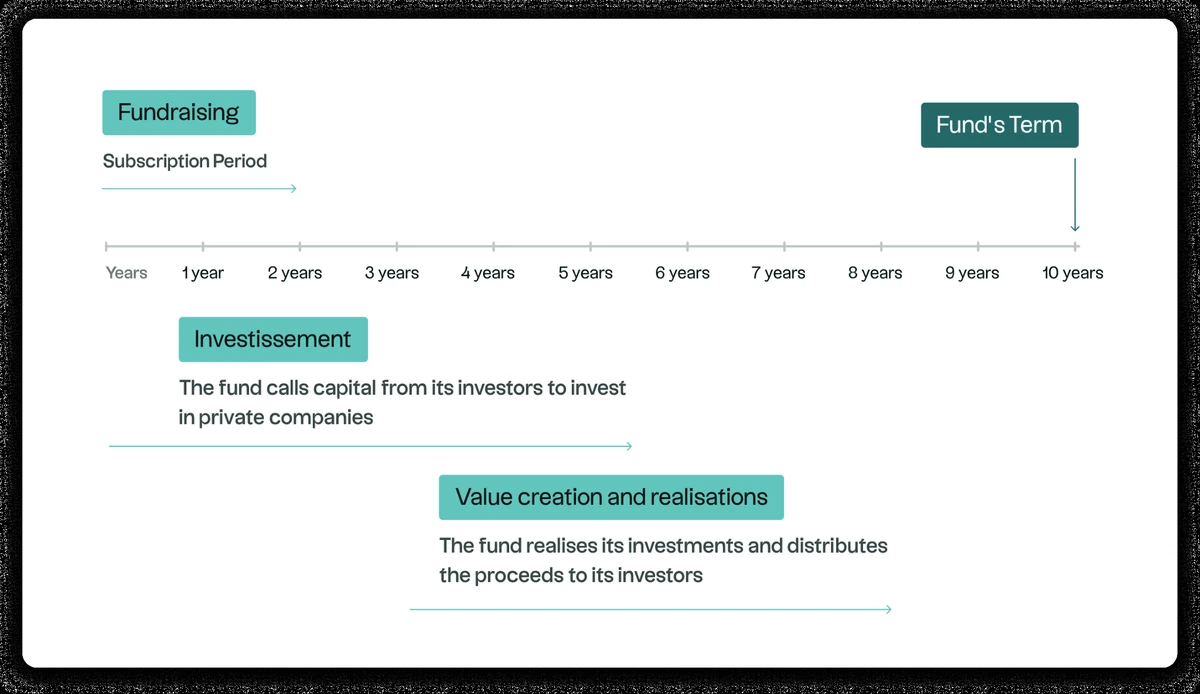
The J curve is part of the classic life cycle of a private equity fund, structured around several successive phases.
Phase 1
The first phase involves fundraising, during which investors commit to a target amount. This commitment does not constitute an immediate investment, but rather a promise to make capital available over the life of the fund.
Phase 2
Next comes the investment period, which generally spans three to five years. During this phase, the management company identifies opportunities, conducts in-depth analyses, structures transactions, and gradually builds the portfolio. Capital calls are made as investments are made.
Phase 3
The next phase is value creation. The management teams provide strategic, operational, and financial guidance to the portfolio companies. This period is often the longest and most critical, but also the least visible in terms of cash flow.
Phase 4
Finally, divestitures occur when companies reach a certain level of maturity or when market conditions permit. Distributions to investors then begin to offset—and eventually exceed—the capital called in, giving the curve its characteristic upward slope.
Illustrative diagram of the life cycle of a private equity fund
Why are performances often negative at the beginning?
The initial negative phase of the J-curve is mainly explained by the structure of cash flows. The early years are dominated by capital calls needed to build the portfolio, while distributions are non-existent or marginal.
Added to this is a cautious approach to valuing investments. At the beginning of the cycle, recently acquired companies have a limited track record under the new governance, which generally leads to conservative valuations.
This accounting conservatism contributes to a performance that appears lower than the underlying economic reality.
Finally, the time lag between the initial investment and the completion of the first disposals explains why value creation is not immediately reflected in performance indicators.
The fundamentals of value creation in private equity
Value creation in Private Equity
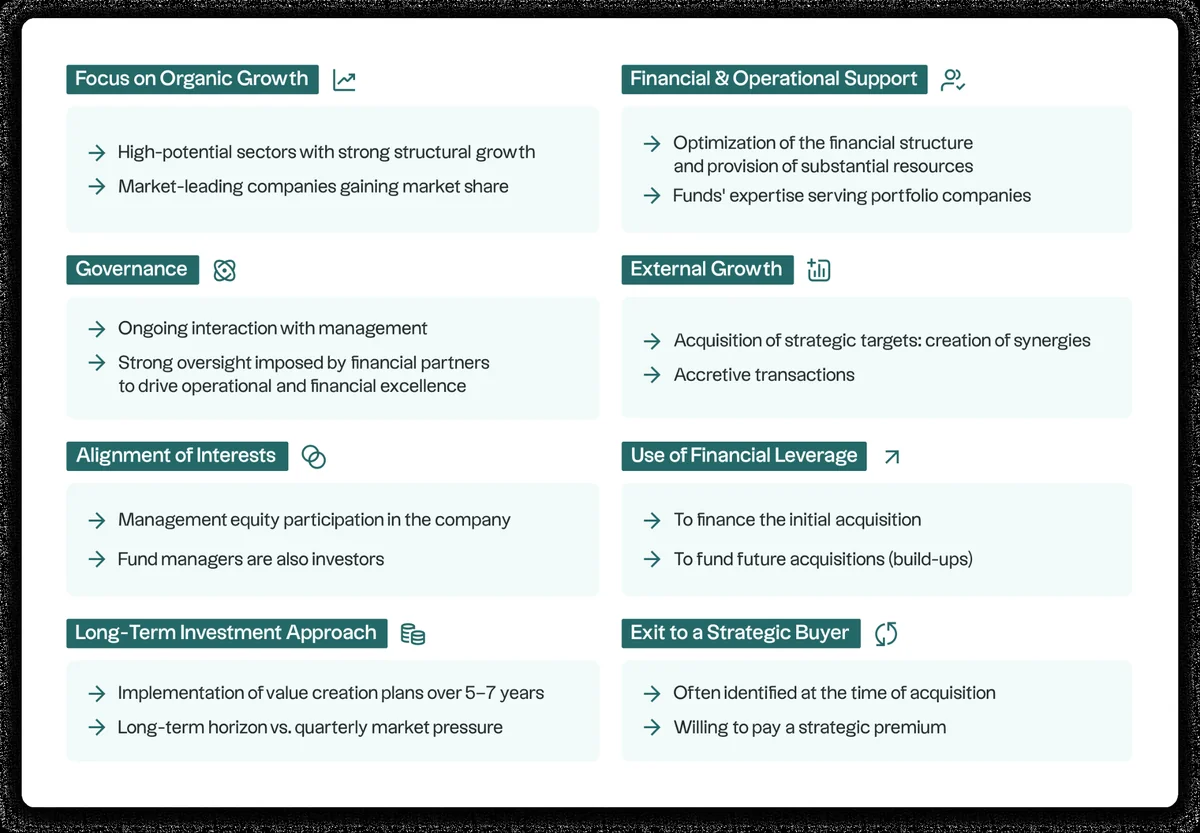
Private equity relies on structural value creation drivers that are specific to this asset class and implemented over the long term. In this video, Louis Flamand, Chief Investment OfficerAltaroc, discusses the main mechanisms at work.
During the investment phase, cash flows are mostly negative, reflecting capital calls and expenses. Net asset value then begins to stabilize as portfolio companies gain visibility and initial operational improvements materialize.
The distribution phase marks a turning point. Disposals generate inflows, which gradually reverse the fund’s cumulative trajectory .
It is this sequence that gives the J-curve its upward slope.
These differences do not constitute standards and do not prejudge the final results.
Institutional interpretation of the J curve
The J-curve is a concept that private equity professionals understand perfectly, but one that is often misinterpreted outside of private equity. In this video, Louis Flamand discusses it based on real-life situations he has encountered throughout his career in fund management. This provides useful insight into how institutional investors really interpret a fund's performance in its early stages, beyond short-term indicators.
The J-curve remains an average representation derived from aggregated observations.
Each fund follows a unique trajectory, influenced by its strategy, the quality of its execution, the investment cycle, and the macroeconomic environment.
The selection of Fund manager a central role in the ability to create value. However, it cannot eliminate the uncertainties inherent in economic cycles and markets.
Strict entry requirements or economic downturns may divert, delay, or alter the expected trajectory.
It is also worth noting that some funds may never experience the theoretical upward phase of the J-curve.
The existence of this concept in no way guarantees a specific outcome.
The J-curve and the risks of private equity
An analysis of the J-curve cannot be separated from the fundamental characteristics of private equity.
Structural illiquidity means that capital is tied up for several years, with no possibility of early withdrawal under standardized terms.
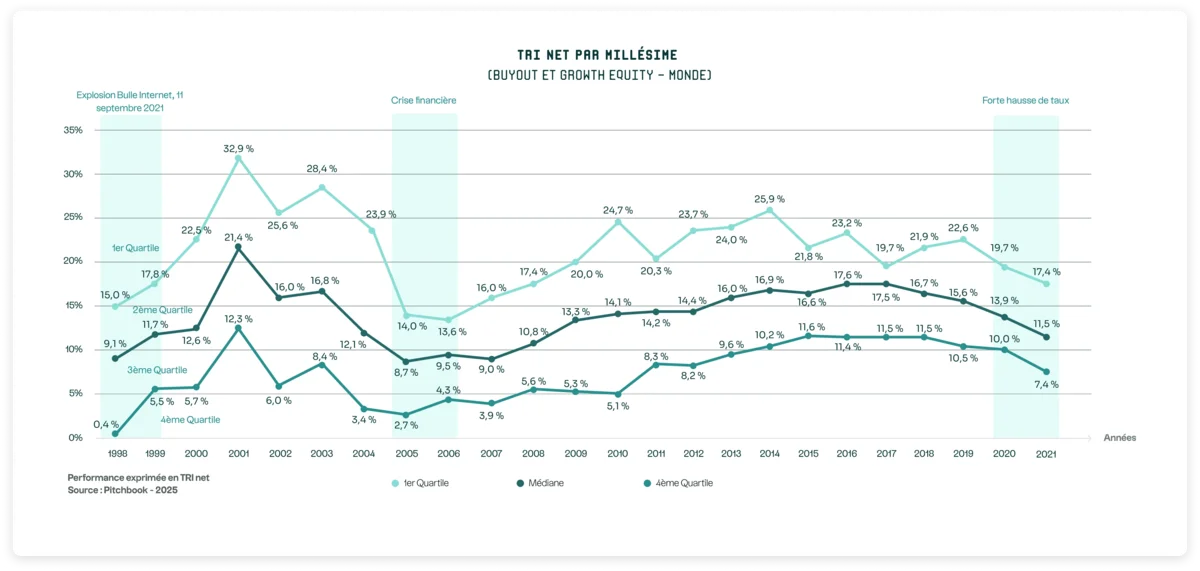
There is significant variation in performance across funds, strategies, geographic regions, and investment cycles. This reflects the idiosyncratic nature of private investments and their dependence on the operational and strategic decisions made by the management teams.
Performance of Private Equity Funds by Quartile
Finally, like any capital investment, private equity carries a risk of partial or total loss of the capital invested. These factors must be fully taken into account in any consideration of this asset class, within a framework tailored to the profile and objectives of each investor.
A Temporal Perspective on Private Equity
The J-curve provides a useful framework for understanding the unique time horizon of private equity. It illustrates the lag between the initial investment effort and the realization of value creation, which is characteristic of long-term strategies.
However, it is neither a universal rule nor a promise of performance. Each fund follows a unique path, shaped by its strategy, execution, and environment.
Understanding this dynamic allows us to approach private equity with a more informed understanding of its mechanisms and constraints.
FAQ
What is the J-curve in private equity?
The J-curve refers to the cumulative performance of a private equity fund over its lifetime, marked by an initial phase that is often negative, followed by a gradual recovery as investments mature and exits occur.
Does the J-curve guarantee future performance?
No. The J-curve is a statistical observation derived from market practices. It does not constitute a guarantee or a forecast of the future performance of a private equity fund.
Why is performance negative at the beginning of a fund?
The initial negative phase can be explained by the gradual calls for funds, the management fees applied from the outset, and the time lag between the investment and the first distributions.
Do all private equity funds follow a J-curve?
No. Each fund has its own specific trajectory, influenced by its strategy, its vintage, the quality of its execution, and economic conditions. Some funds may never exhibit the theoretical J-curve shape.
What are the risks associated with private equity?
The main risks include high illiquidity, significant performance dispersion, dependence on economic cycles, and the risk of capital loss. These characteristics are inherent in unlisted investments.
Private Equity: Everything you need to know about private equity
Private equity is a key asset class in supporting the growth of unlisted companies. By providing long-term capital and strategic support, private equity contributes to the development, transformation, and value creation of SMEs and mid-cap companies. Understanding its mechanisms, performance, and risks is essential to assessing its role in long-term asset allocation.
Salma Moumen is Chief Project Officer at Altaroc. A graduate of TBS Education with a specialization in Banking & Corporate Finance, she began her career by assisting fintech companies with their fundraising efforts before focusing on the digital transformation of financial sector players, at the intersection of business and technology challenges. Through her articles, she offers an informative, well-researched, and objective analysis of private markets, their mechanisms, and the risks associated with them.
In accordance with applicable regulations, we ask that you complete your profile. This step is required to access the content and services offered on our websites.
Please fill out your profile to access the site
country of tax residence
Select
choosenCountry
Preferred language
Select
choosenLang
YOUR INVESTOR PROFILE
Financial intermediary or professional investor
Financial advisors, wealth managers, private bankers, or any other investment service providers.
Qualified Investor or Altaroc Investor
Experienced investor or Altaroc investor
Private investors who have already invested with Altaroc or who have a minimum investment capacity of €100,000.
Private investors who have previously invested in Altaroc who have a minimum investment capacity of 200,000 euros.
Non-professional (retail) investor
Individual investors with an investment capacity below €100,000.
Retail investors with an investment capacity of less than 200,000 euros.
Institutional investor
Pension funds, retirement schemes, asset management companies, and single-family offices.
Important information
choosenTerms
choosenTermsValue
Select your language and investor profile to continue
Select your investor profile to continue
Scroll down to accept General Terms and Conditions












_5_11zon.webp)

_1_11zon.webp)