Home
Resources
Mastering the challenges of private equity
...

The software sector: a key asset class for private equity

Published on
15/10/2025
Amended on
6/11/2026
0
minute(s)
Strategic focus: software sector
Discover the new Strategic Viewpoint by Louis Flamand, CIO ofAltaroc. Once a quarter, our Chief Investment Officer deciphers the major trends that are transforming private equity over the long term.
By
Louis Flamand
Louis Flamand
The software sector: a key asset class for private equity
This article has been automatically translated. Please excuse any inaccuracies or translation errors.
Dieser Artikel wurde automatisch übersetzt. Bitte entschuldigen Sie etwaige Ungenauigkeiten oder Übersetzungsfehler.
This article has been automatically translated. We apologize per inaccuracies or translation errors.

In this first issue, he looks at the software sector in private equity and how it has emerged as one of the strongest drivers in recent years. 

What are the key points to remember from the document? 

1. A strategic sector for private equity funds

  • Historically funded by venture capital, the software sector is now a major asset class in LBO.
  • The shift to the SaaS model has transformed the nature of revenues:
    • Recurring subscriptions (ARR 85-95% of sales)
    • High visibility and predictability of flows
    • Taux de désabonnement faibles (<5 %)
  • By 2024, the global SaaS market will exceed $200 billion, with a CAGR >15% (source: Gartner).
  • The historical dependence on key talent (engineers, developers) is now largely under control thanks to professionalization and long-term incentives (shares, bonuses, DevOps culture).

2. Exceptionally strong economic fundamentals

  • Scale effects: marginal costs are virtually nil once the software has been developed → EBITDA margins can reach 30-40%.
  • Iso-customer growth :
    • Upsell & Cross-sell: increased value per customer without additional acquisition costs.
    • Pricing Power: price increase justified by the software's critical value.
  • Key indicator: the "Rule of 40" (Growth % + EBITDA margin %).
    • The best publishers exceed 60 points, a sign of an optimal balance between growth and profitability.

3. A massive, resilient market

  • Worldwide software spending multiplied by 7 in 20 years, to exceed $1,000 billion.
  • Software now accounts for 60% of the volume and 58% of the total value of private equity tech deals (PitchBook 2024).
  • Funds specializing in the sector posted a IRR of 28.3% between 2017 and 2019 (compared with 15% for the overall private equity sector).
  • Resilience confirmed: even in a difficult macro context, demand remains strong and qualitative ("flight to quality").

‍

4. Attractive valuations once again

  • After the bubble of 2021, valuations normalized:
    • 25-30x EBITDA for the best profitable publishers,
    • 6-8x sales for companies not yet profitable.
  • The post-2022 rebound offers an attractive entry point into a sector with strong structural growth.

‍

5. Software funds: a clear competitive advantage

  • Sector expertise and pattern recognition: precise targeting of the most promising sub-segments.
  • Proven playbook :
    • Operational optimization (sales, marketing, pricing, data)
    • Buy & Build strategies to create sector champions
    • Refocusing on more profitable products
  • Expert in-house teams: data, AI, cybersecurity, FP&A, HR, ESG, etc.
    → These funds now operate like true SaaS publishers, but with a Private Equity approach.

‍

6. Artificial Intelligence: a performance catalyst

  • AI reinforces critical software (ERP, HR, finance, supply chain) rather than replacing it.
  • Estimated gains: +5 to +12 EBITDA margin points over the next few years.
  • AI-enabled editors benefit from :
    • Increased barriers to entry (network effects & proprietary data)
    • Enhanced perceived value for customers.
  • Only software with little differentiation (marketing, reporting, basic BI) risks disruption.

‍

7. Prospects for structural growth

  • Transition to the cloud still incomplete: only 36% of workloads hosted (target 53% by 2026).
  • Global technical debt: $1.5 trillion → opportunity to modernize and migrate to SaaS.
  • SaaS + AI: the combined growth and value driver.
  • The software sector now attracts $200 billion in "dry powder" (uninvested funds raised).

‍

8. Conclusion - A lasting opportunity for investors

  • Sector with structural growth, recurring revenues, high profitability.
  • Fueled by digital transformation and AI, it combines:
    • Visibility of cash flows,
    • The power of scale effects,
    • Consolidation potential through Buy & Build.
  • SaaS publishers remain premium private equity targets - a strategic pillar in long-term portfolios.

‍

Detailed analysis here

‍

Other content in this topic

Explore our content collections, which bring together different formats around a single subject/issue/theme.
School Dropouts: How Private Equity Can Fund Education
Mastering the challenges of private equity
School Dropout Rates: How Private Equity Can Fund Education
How can we provide sustainable funding for organizations working to combat school dropout rates? This question was at the heart of the first edition of the Grand Forum de l’Éducation, organized on Thursday, October 15, at the Conservatoire national des arts et métiers in Paris by the AlphaOmega Foundation. While the funding needs of nonprofit organizations remain considerable, Maurice Tchenio, CEO ofAltaroc and president of the AlphaOmega Foundation, alongside Patrick Sapy, CEO of FAIR Finansol, advocated for an approach that has yet to be fully explored in France: leveraging private equity to bolster foundations’ resources and enable them to support nonprofit organizations over the long term.
Article
|
19
2026-10-19
2027 Budget Bill | Analysis
Mastering the challenges of private equity
2027 Budget Bill - An Analysis of the Wealth-Related Measures
The 2027 Finance Bill was introduced in the National Assembly on October 1, 2026; it is expected to be adopted before December 31, following review by the National Assembly and then by the Senate. The measures outlined below, relating to estate planning issues in Articles 2, 3, 4, 5, 6, 7, and 10, are those contained in the Government’s initial draft and are subject to change—or even removal—during parliamentary debates.
Article
|
07
2026-10-07
Portrait Merrick McKay
Mastering the challenges of private equity
Merrick McKay (Abrdn): the advantages of investing in specialized Private Equity funds
For Private Equity specialists Merrick McKay and Louis Flamand, investment in specialized funds is crucial to company growth. McKay stresses the difficulty for generalist funds to compete with this expertise. Flamand also discusses the European market's move towards sector specialization. They discuss the complexity of investing with over-demanded managers.
Article
|
04
2024-03-04
Portrait of Merrick McKay
Mastering the challenges of private equity
Merrick McKay (Abrdn): It's always a good time to invest in private equity
Abrdn's Merrick McKay maintains that it's still a good time to invest in Private Equity, despite the global economic climate. He stresses the importance of choosing the best funds for optimal returns, with a median performance in Europe of 15-16% over the past 20 years.
Article
|
23
2024-02-23
Building a long-term private equity allocation
Mastering the challenges of private equity
Building a long-term private equity allocation
Watch the full recording of the webinar “ Altaroc ” and learn how to build a sustainable private equity portfolio, inspired by the practices of institutional investors.
Video
|
22
2026-09-22
Best Of: Building a Long-Term Private Equity Portfolio
Mastering the challenges of private equity
Best Of: Building a Long-Term Private Equity Portfolio
Check out the highlights from the “ Altaroc ” webinar, which focuses on how institutional investors build a sustainable private equity portfolio and support your clients’ wealth management strategies.
Video
|
25
2026-09-25
Interview with Charly Zwemstra—Founder, CEO, and CIO— Main Capital Partners
Mastering the challenges of private equity
Interview with Charly Zwemstra—Founder, CEO, and CIO— Main Capital Partners
Charly Zwemstra unveils Main Capital Partners' strategy for transforming B2B software companies into global leaders.
Video
|
22
2026-09-22
Interview with Antoine Levy, Economist - Berkeley
Mastering the challenges of private equity
Interview with Antoine Levy, Economist - Berkeley
From Berkeley, economist Antoine Levy explains why the pay-as-you-go pension system can no longer withstand the demographic shock.
Video
|
24
2026-08-24
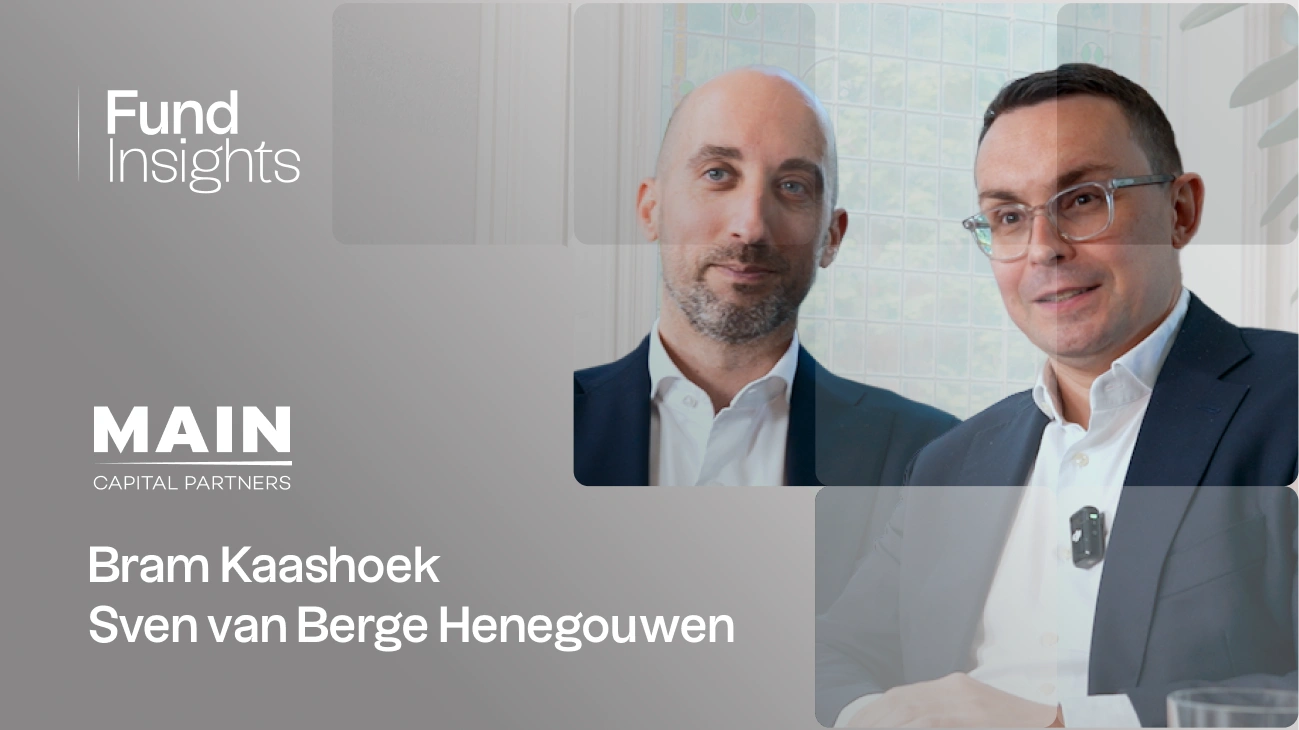
Interview - Sven van Berge & Bram Kaashoek - Main capital
Mastering the challenges of private equity
Interview - Sven van Berge & Bram Kaashoek - Main capital
Sven van Berge & Bram Kaashoek explain how artificial intelligence is redefining value creation and business models for B2B software publishers
Video
|
11
2026-06-11
Strategic Consideration—Waiting for Dividends: The Hidden Cost
Mastering the challenges of private equity
Strategic Consideration—Waiting for Dividends: The Hidden Cost
Find out why waiting for a fund’s distributions before reinvesting can reduce the performance and diversification of a private equity portfolio.
File
|
25
2026-09-25
Strategic Point - Evergreen
Mastering the challenges of private equity
Strategic Point - Evergreen
Check out our analysis in the latest Strategic Briefing
File
|
21
2026-04-21
Flash Market - AI & B2B software
Mastering the challenges of private equity
Flash Market - AI & B2B software
A dynamic of reinforcement, not replacement
File
|
15
2026-02-15
Special Report - New Mountain Capital
Mastering the challenges of private equity
Special Report - New Mountain Capital
New Mountain Capital adopts a Defensive Growth investment strategy, focusing on high-growth, non-cyclical sectors. Each year, the team identifies resilient sub-sectors, which it explores in depth through an in-house "Deep Dive Process". The firm is particularly well known in the healthcare sector, including life sciences and healthcare IT, as well as in segments at the crossroads of technology and infrastructure services.
File
|
10
2025-04-10
Special report - Thoma Bravo
Mastering the challenges of private equity
Special report - Thoma Bravo
Featured in the Vintage Altaroc Odyssey , Thoma Bravo is a U.S.-based private equity firm specializing in the software sector. Founded by Carl Thoma and Orlando Bravo, it takes an approach focused on margin optimization and external growth. With more than 220 employees, including about 100 investment professionals, it has offices in San Francisco, Miami, Chicago, London, New York, and Dubai. Thoma Bravo manages more than $166 billion in assets across its various fund portfolios.
File
|
13
2025-03-13
No articles in this category yet.
Welcome to Altaroc
In accordance with applicable regulations, we ask that you complete your profile. This step is required to access the content and services offered on our websites.
Please fill out your profile to access the site
country of tax residence
Select
choosenCountry
Preferred language
Select
choosenLang
YOUR INVESTOR PROFILE
Financial intermediary or professional investor
Financial advisors, wealth managers, private bankers, or any other investment service providers.
Qualified Investor or Altaroc Investor
Experienced investor or Altaroc investor
Private investors who have already invested with Altaroc or who have a minimum investment capacity of €100,000.
Private investors who have previously invested in Altaroc who have a minimum investment capacity of 200,000 euros.
Non-professional (retail) investor
Individual investors with an investment capacity below €100,000.
Retail investors with an investment capacity of less than 200,000 euros.
Institutional investor
Pension funds, retirement schemes, asset management companies, and single-family offices.
Select your language and investor profile to continue
Select your investor profile to continue
Scroll down to accept General Terms and Conditions
The webpage you are trying to access is not available in your country.