

Cincy Inno Dedicates 80 Acres Farms to Its Disruptive Innovations in Agricultural Technology
Cincy Inno is an online media outlet dedicated to innovation and tech news in the Cincinnati, Ohio area. It is part of the American Inno network, a group of local publications belonging to the American City Business Journals group, which also publishes the Cincinnati Business Courier.
In practical terms, what does this award highlight? 80 Acres Farms offers a wide range of innovations and promise: against the backdrop of a global population boom, the issue of agriculture is crucial yet often overlooked. That’s where this Ohio-based company comes in with its indoor vertical farms. Yet this modern production method remains unfamiliar to many people, even though its benefits are undeniable: zero pesticides, local production, and vegetables grown in facilities powered 100% by renewable electricity that require 95% less water than traditional crops. Finally, it offers the potential to grow 300 times more food per square meter than conventional farming. This isn’t the first time the company has been recognized for its innovations.
Unanimous recognition within the tech and innovation ecosystem
The award from Cincy Inno is the latest in a series of prestigious accolades recognizing the company's achievements. 80 Acres Farms has earned numerous national and regional awards in recent years, solidifying its position as a leader in controlled-environment agriculture (CEA).
In particular, the company was recognized at Fast Company’s World Changing Ideas Awards, which honor technologies capable of addressing major societal and climate challenges. It was also featured in TIME magazine’s list of the Best Inventions of the Year, a major accolade for its ability to bring consumer products (lettuce, strawberries, tomatoes) of consistently high quality to market on a large scale. At the regional level, Ohio Business awarded the company its Entrepreneurial Excellence Award, highlighting its impact on local employment and industrial revitalization through its automated plants in Hamilton.
Comparative Analysis: Performance Metrics vs. the Traditional Model
The success of 80 Acres Farms—as evidenced by these awards and the interest shown by major investors—is based on a mathematical performance gap compared to traditional horizontal farming:
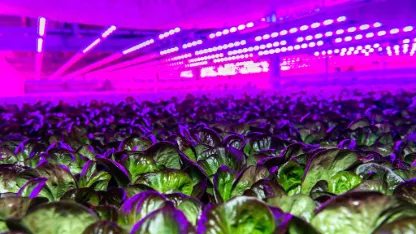
- Yield and Space Utilization: By stacking grow modules on multiple levels under optimized LED lighting, a single 80 Acres Farms facility produces up to 300 times more food per square meter than an open-field farm. This concentration avoids land development and brings production closer to urban centers.
- Resource consumption: Closed-loop irrigation captures plant transpiration through the air handling unit, purifies the water, and recirculates it back into the system. This mechanism saves 95% of water compared to conventional agricultural irrigation, while eliminating the risk of groundwater pollution, since no pesticides are used at all.
- Financial Structure (CapEx vs. OpEx): While conventional agriculture requires a lower initial investment, it is heavily impacted by seasonal volatility, the cost of chemical inputs, and weather-related risks. The 80 Acres Farms model requires significant initial capital expenditures (CapEx) to automate the facilities, but offers highly predictable operating costs (OpEx), continuous production 365 days a year, and stable margins that are protected from climate-related crises.
What Consumers and Chefs Say: Taste at the Heart of the Strategy
In the field, the elimination of pesticides and harvesting at full maturity translate into a direct commercial advantage that is evident on store shelves. Department managers at major partner grocery chains (such as Kroger and Albertsons) and regional managers highlight the difference in quality on a daily basis.
Customer feedback highlights a crisper texture and much more pronounced flavors compared to products that have undergone long refrigerated shipments from California or Mexico. Furthermore, the purity of products grown in a sterile environment extends their shelf life by several days—a compelling argument that significantly reduces markdowns and food waste for retailers.
Financial clout to support the development pipeline
To date, 80 Acres Farms has raised more than $400 million and completed a major $115 million funding round to expand its distribution network and invest in additional farms. The company has also finalized the acquisition of Plantae Biosciences, an Israeli company specializing in plant biotechnology, followed by the purchase of three indoor farms from Kalera Inc. located in Colorado, Georgia, and Texas, thereby strengthening its production capacity.
This financial foundation supports an ambitious development pipeline focused on geographic expansion and agronomic diversification. The integration of Plantae Biosciences’ patents enables the company to accelerate its research into the genetics of non-modified (non-GMO) seeds in order to adapt new varieties of fruits and vegetables to indoor growing conditions.
The rollout of Kalera’s three existing sites—which have been fully upgraded with the GroLoop software technology developed by its subsidiary Infinite Acres—will enable the group to replicate its model in the southern and western United States. In the long term, this nationwide network aims to position 80 Acres Farms as the leading national supplier of fresh produce with a minimal carbon footprint, capable of supplying the country’s largest restaurant and distribution networks.






.webp)