
Vertical Farming: 80 Acres Farms Tops the TIME and FoodTech 500 Rankings
Over the past 20 years, the amount of freshwater available per person has fallen by more than 20% worldwide, due to the combined effects of climate change and rising food demand. At the same time, traditional agricultural systems are under increasing pressure. They must produce more with fewer resources and under more unstable climatic conditions. It is precisely in this context that 80 Acres Farms was developed, enabling the cultivation of 300 times more food per square meter through vertical farming, while saving more than 297 million liters of water each year.
An environmental innovation initiative praised by TIME
The Ranking America’s Top GreenTech Companies 2026, compiled by the prestigious TIME magazine—a historic publication founded in 1923 and read by millions of readers every month—in partnership with data analytics firms, has just recognized the company’s trajectory. This ranking aims to identify the most innovative American companies in environmental technologies. The ranking is based on a combination of several criteria: actual environmental impact (emissions reduction, resource efficiency), technological innovation, and financial strength or growth.
Based in Ohio, 80 Acres Farms has made sustainability one of its core values. In addition to producing fresh, pesticide-free food, the company prevents more than 135 metric tons of food waste each year. To support this operational efficiency, it also collaborates with engineering giant Siemens to ensure optimal water and electricity management at its facilities. Recognized for its leadership, the company also raises awareness on a large scale about the benefits of vertical farms, notably at the UN.
Ranked 2nd globally out of more than 1,200 candidates on the FoodTech 500 list
The FoodTech 500 is a leading global ranking compiled by Forward Fooding, a major media outlet covering agri-food innovation with over 350 million readers each month. Every year, Forward Fooding analyzes more than 1,200 cutting-edge applications from nearly 180 countries.
Among the 1,200 contenders on this prestigious list, 80 Acres Farms rose to second place worldwide, just behind Pairwise (an American technology company that uses gene editing to improve the lifespan of plants).
Infinite Acres: The Technological Building Block That Makes the Model Scalable
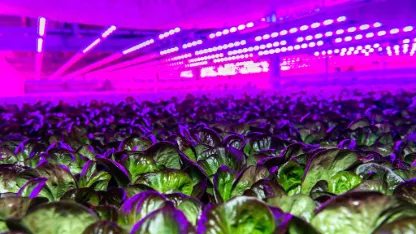
The American company owes part of its success to Infinite Acres, its technology subsidiary that designs and operates indoor farms where plants grow without sunlight or soil, in fully controlled environments (LED lighting, temperature, humidity, nutrients). This allows for year-round production, close to cities, with high yields and very little waste.
Infinite Acres combines proprietary software, robotic automation, energy management, and agronomy into a comprehensive, replicable, and scalable system. While many vertical farming projects remain experimental or isolated, 80 Acres Farms seeks to create a standardizable model that can be rapidly deployed in different countries.
Comparative Analysis: 80 Acres Farms vs. the AgTech Giants
80 Acres Farms' ranking in the FoodTech 500 highlights the effectiveness of its technological choices compared to other heavyweights in controlled-environment agriculture (CEA):
- Agricultural Approach: While companies like AeroFarms have historically focused on aeroponics (roots suspended in the air and misted), 80 Acres Farms has streamlined its infrastructure costs by optimizing automated closed-loop hydroponics. Its recent merger with Soli Organic also provides it with unique expertise in sterile indoor growing media, expanding its product lineup to include high-quality herbs.
- Mastery of Diversification: Unlike many agritech startups, which are limited to monocultures of lettuce and leafy greens, 80 Acres Farms has successfully industrialized the production of fruit vegetables (tomatoes, mini cucumbers) and delicate fruits (strawberries), thereby capturing higher-margin market share in the mass retail sector.
- Financial Stability: The sector has undergone a period of rigorous consolidation. Companies with business models that were too capital-intensive in terms of operating expenses (OpEx) have had to restructure their operations. By leveraging Infinite Acres’ standardized software architecture, 80 Acres Farms achieves greater energy efficiency per kilogram of produce, reassuring major retail chains such as Kroger and Albertsons of its ability to fulfill multi-year supply contracts at fixed prices.
Financial Strength and Accelerated International Expansion
To support this scaling up, 80 Acres Farms relies on a solid financial structure, having raised more than $400 million to date. Its recent funding rounds were led by major international institutional investors such as General Atlantic, have been specifically earmarked for the geographic expansion of its facilities (notably its $120 million mega-farm in Covington, Georgia) and for the integration of key technology assets, such as the acquisition of the plant biotechnology company Plantae Biosciences.
This financial foundation paves the way for the group's international expansion. The growth pipeline calls for exporting the Infinite Acres model beyond North American borders. Strategic partnerships and joint ventures are currently being explored to establish these standardized structures in regions subject to severe water or climate constraints—particularly in the Middle East and Eastern Europe—where food sovereignty has become a matter of national security.




.webp)