
What is private equity?
Private equity refers to investments made in unlisted companies. Private equity supports the growth and transformation of companies.
These strategies are aimed at established companies and are designed for the long term, characterized by illiquidity and the risk of capital loss.
Definition of private equity
Private equity, which forms the basis of private equity, refers to investment in unlisted companies via dedicated funds.
The objective is to support the development, restructuring, or transition of already established companies. This is carried out within a framework governed by professional teams and a long-term perspective.
The major strategies of private equity
Private equity encompasses a range of strategies that differ mainly in terms of the profile of the companies financed and the objectives pursued by investors.
From start-ups in the launch phase to mature companies or those undergoing restructuring, each segment responds to specific economic and operational logic.
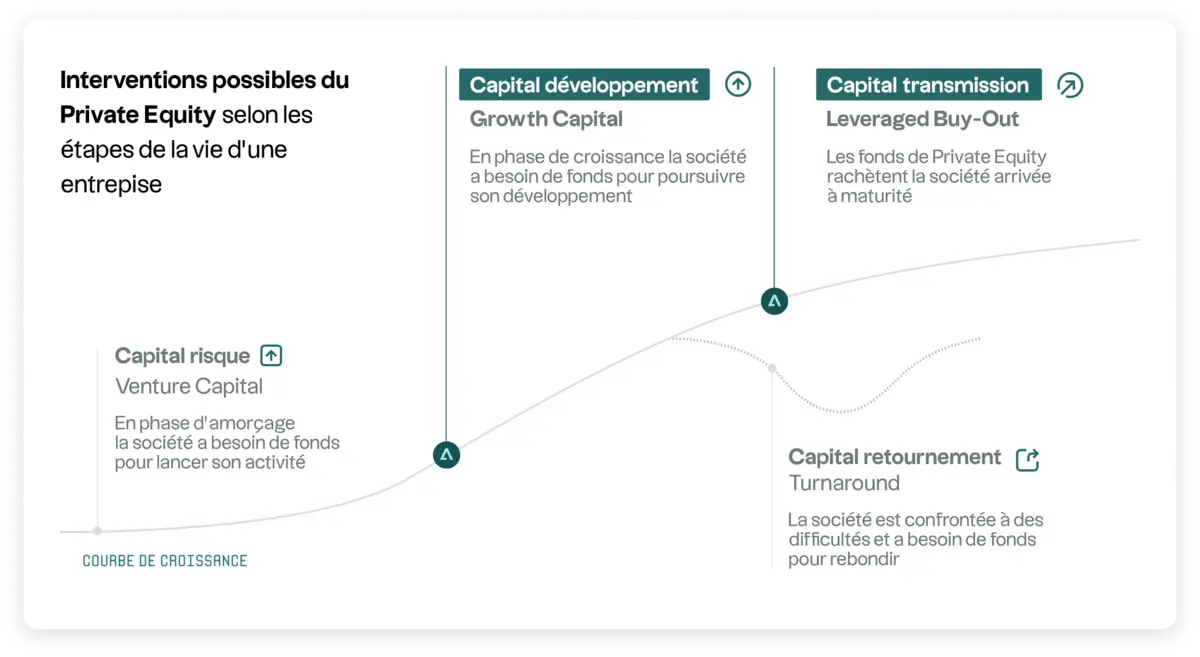
Four major structural segments can thus be identified :
- Venture capital is involved from the earliest stages of development to finance innovation and initial growth.
- Growth capital supports SMEs or mid-sized companies that are already established and in a phase of acceleration and structuring.
- Transfers or LBOs target mature companies in order to optimize their governance and operational leverage.
- Finally, special situations concern companies in difficulty, with the aim of stabilizing and turning around their business.
The table below summarizes these segments to facilitate reading and comparison.
How does a private equity fund work?
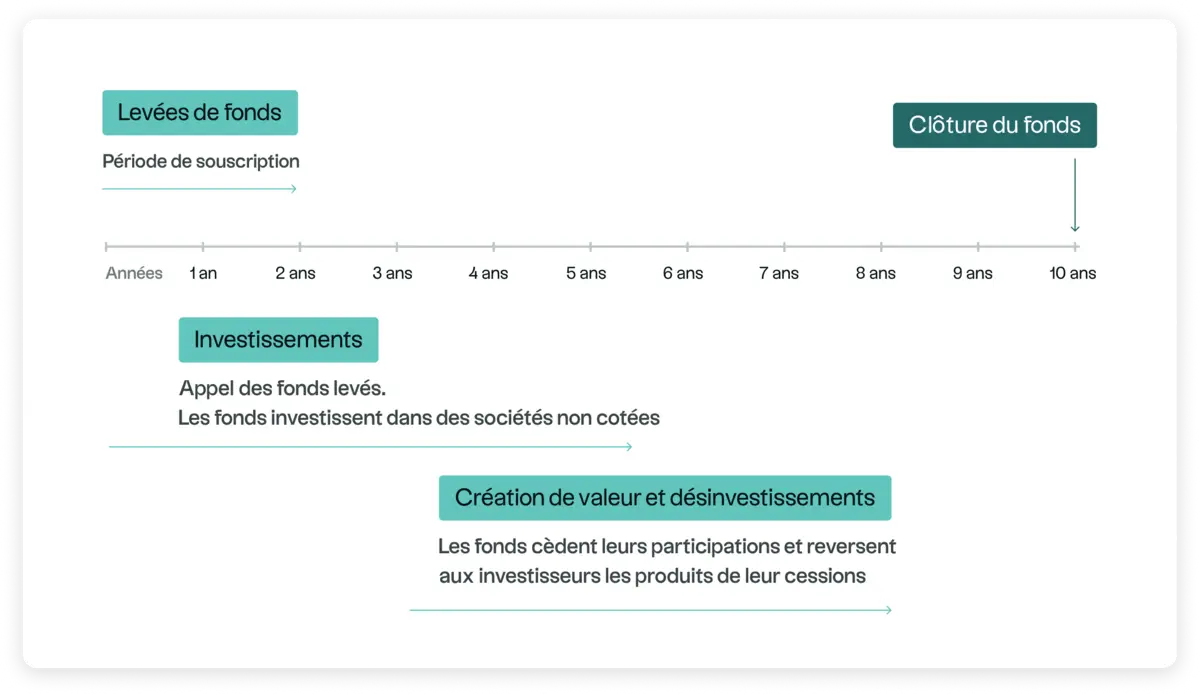
A private equity fund follows a structured life cycle consisting of several stages:
- Fund raising, during which investors commit for the entire duration of the vehicle
- Investment phase (3–5 years) devoted to selecting and acquiring equity interests
- Period of value creation, focused on growth, operational performance, and good governance
- Disposals, when conditions permit
- Distributions, as releases become available
This cycle generally spans 8 to 12 years, reflecting the long-term and illiquid nature of private equity.
What is venture capital?
Definition
Venture capital is the segment of private equity dedicated to financing innovative start-ups. These companies are often in the seed or early development phase.
This segment of private equity presents a particularly high level of uncertainty due to the immaturity of the companies and the lack of financial history.
The role of venture capital in innovation
Venture capital contributes to:
- the emergence of new technologies,
- financing disruptive solutions,
- the structuring of innovative ecosystems (AI, health, energy, cybersecurity, etc.).
He therefore supports projects whose trajectory depends heavily on their ability to achieve sufficient adoption.
How does a VC fund support start-ups?
Venture capital funds generally intervene at a very early stage, providing:
- progressive financing (seed, Series A/B/C),
- strategic support for founding teams,
- access to a network of expertise and partners,
- support on internal structuring issues (organization, governance, recruitment, etc.).
The failure rate in this universe is nevertheless high, resulting in a marked dispersion of performance.
Private equity vs venture capital: what are the differences?
Objectives
Venture Capital
Venture capital aims to finance innovation and the emergence of new business models, often before the company has proof of scale. VC intervenes at the moment when uncertainty is at its highest, to support technologies, uses, or concepts that are still under development. Its objective is not optimization, but rather the validation and acceleration of emerging innovation.
Private Equity
The objective of private equity is to support established companies during key phases of their development, whether this involves optimizing their operational performance, structuring their governance, or supporting strategic transformation. PE acts as a long-term partner, mobilizing financial and managerial resources to strengthen the trajectory of companies that already have solid fundamentals.
Business maturity
Venture Capital
Venture capital funds target young companies with limited traction, sometimes without a complete financial history, whose product, market, or business model remains to be proven. This structure implies a high degree of information asymmetry and limited visibility on the future trajectory.
Private Equity
Private equity invests inmature companies with identifiable cash flows and consolidated operating indicators. This maturity provides a more in-depth basis for analysis, but does not eliminate the risks associated with market developments, strategic decisions, or economic cycles.

Risk and volatility
Venture Capital
VC presents a particularly high risk, characterized by high volatility and significant performance dispersion. The proportion of companies that do not make it past the initial stages is structurally high, which has a significant impact on portfolio construction and risk management.
Private Equity
Private equity benefits from greater operational visibility due to the maturity of the companies financed. Nevertheless, the risk remains significant, particularly due to illiquidity, market cyclicality, and the total absence of capital guarantees. Results vary greatly depending on managers, strategies, and vintages.
Horizon
Both strategies are part of a long-term investment strategy.
Venture Capital
The VC horizon is more uncertain, as success depends on companies' ability to navigate several stages of development, often linked to changes in technological, regulatory, or sectoral cycles. Exit times can vary greatly.
Private Equity
Private equity operates within a more structured timeframe , generally between 8 and 12 years, corresponding to the typical cycle of a fund (investment, support, divestment). This structure does not guarantee results, but it does provide a more predictable framework for management and value creation.
Admission ticket and selection
Venture Capital
VC relies on a highly concentrated selection process, in which only a few projects have sufficient development potential to offset the segment's high failure rate. The quality of the founding team, technological relevance, and execution capacity are determining factors.
Private Equity
Private equity requires a more extensive operational, financial, and strategic analysis. Management teams examine in detail: the quality of management, industry dynamics, governance structure, cash flow generation, and identifiable levers for transformation.
This rigorous analysis contributes to a better understanding of the risks, without however eliminating the uncertainty inherent in unlisted markets.
How to invest in private equity?
The historic access routes
Historically, private equity was mainly accessible to institutional investors, high net worth individuals, and family offices. This limited accessibility can be explained by the minimum amounts required, the technical nature of the strategies, and the length of the commitment required.
As regulations have evolved, regulated solutions have enabled broader access, subject to eligibility requirements, awareness of risks, and understanding of the illiquid and long-term nature of this asset class.
The role of professional managers
Professional managers play a central role in the functioning of private equity. Indeed, a fund's performance depends largely on the quality of the decisions made at each stage of the investment cycle.
However, it should be noted that investing in private equity offers no guarantees.
The managers' involvement is based on a combination of financial, operational, and sector expertise, deployed over the long term.
Professional managers are responsible for:
1 - A rigorous and methodical selection of companies
The teams conduct in-depth analyses of the robustness of the business model, the management's ability to execute its strategy, and the resilience of the business to sector cycles.
This selection is based on financial, legal, operational, and extra-financial due diligence, conducted using proven methodologies.
2 - In-depth and ongoing sector analysis
Private equity requires in-depth knowledge of the dynamics specific to each sector: competition, innovation, regulation, and structural trends.
This analysis enables companies to position themselves within their environment, anticipate possible developments, and identify levers for value creation.
3. Operational capacity at the service of the companies we support
Managers help structure organizations by working on governance, strategy, internal organization, resource management, and digitalization issues.
This operational involvement varies depending on the strategy (growth capital, buyout, special situations) but is a key element of the support provided.
4. Strong discipline in value creation
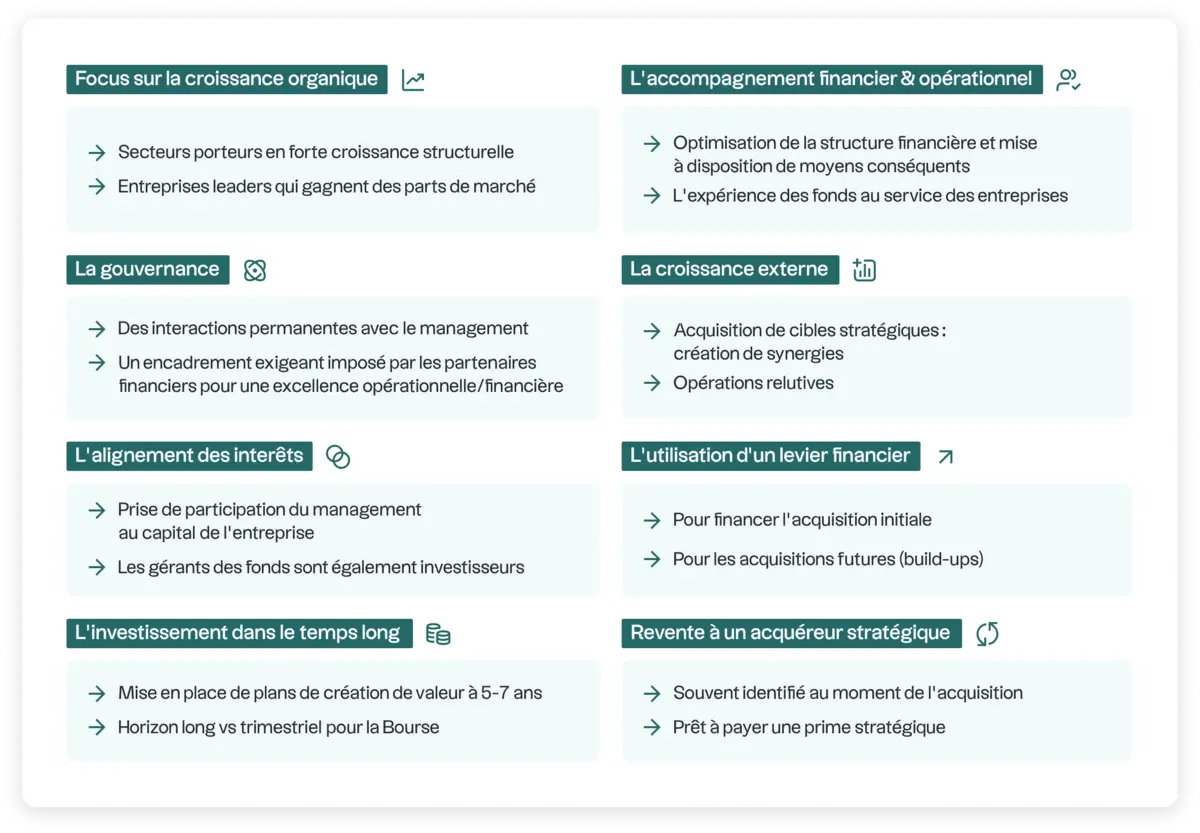
The managers define a specific action plan, implemented over several years, aimed at supporting growth, optimizing processes, and strengthening governance.
This discipline does not guarantee results, but it provides professional guidance for the trajectory of the companies financed.

5. Structured management of exit strategies
Exits (industrial sale, secondary market, IPO, refinancing, etc.) are planned based on market conditions, the maturity of the company, and the options available.
The objective is to ensure an exit that is consistent with the fund's strategy, in a context that remains subject to economic uncertainty.
6. Continuous monitoring of risks and performance
Management teams regularly assess operational, financial, and sector risks, adapting their strategy when necessary.
This structured approach helps control the investment cycle, while recognizing that the risk of capital loss remains present.
By bringing together these areas of expertise, professional managers play an essential role in structuring, supporting, and enhancing the value of the companies they finance, within a framework subject to illiquidity, uncertainty, and the variability of economic cycles.


.webp)
.webp)








.jpeg)
.jpeg)