Investing in Private Equity: 6 strategic reasons and points to consider
Published on
05
Amended on
16
Investing in private equity involves allocating capital to unlisted companies via specialized funds, with a view to providing strategic support and transformation over the long term.
This article has been automatically translated. Please excuse any inaccuracies or translation errors.
Dieser Artikel wurde automatisch übersetzt. Bitte entschuldigen Sie etwaige Ungenauigkeiten oder Übersetzungsfehler.
This article has been automatically translated. We apologize per inaccuracies or translation errors.
An opportunity to access growth in the unlisted economy
For several years now, an increasing share of companies’ value creation has been occurring prior to a potential initial public offering.
According to McKinsey & Company, companies today remain private for longer than in the past, shifting a significant portion of growth toward private markets. This trend is particularly evident in the technology sectors, among specialized industrial companies, and among many family-owned businesses that prefer to grow outside of public markets.
Investing in private equity provides access to this universeof unlisted companies, whether throughgrowth, succession, transformation, or international expansion transactions. This asset class thus offers exposure that complements listed markets and allows fordirect investment in the real economy.
However, this access comes with specific characteristics. Unlisted companies generally disclose less financial information than listed companies, and their securities are not traded on an organized market. Investment analysis therefore relies more heavily on the stock-picking efforts of investment management firms, while liquidity remains structurally more limited than in stock markets.
Seeking illiquidity premiums in a controlled manner
Financial theory suggests that accepting a lock-up of capital can provide access to an illiquidity premium. Private equity follows this logic, in exchange for a commitment that generally ranges from eight to twelve years.
However, this illiquidity premium is neither automatic nor guaranteed. It depends on the quality of the selected assets, the entry price, the economic environment, and the manager’s discipline. Illiquidity can also become a constraint if the overall asset allocation is not consistently calibrated.
Investing in private equity therefore requires rigorous wealth planning and a genuine ability to tie up capital for the duration of the fund.
Private Equity: Understanding a Strategic Asset Class
Private equity remains a relatively unknown asset class, even though it occupies a central place in institutional investors' allocations. Private equity can be a useful lever for investors seeking to diversify their portfolios and build wealth over the long term.
However, understanding private equity requires a grasp of its mechanisms, value drivers, and structural constraints, particularly in terms of illiquidity and capital risk.
Read our comprehensive analysis to understand how private equity works, its advantages, and the key points to watch out for.
Unlike public markets, where part of the return may stem from fluctuations in valuation multiples, private equity derives most of its value creation fromimprovements in operational fundamentals.
Organic growth, margin optimization, governance restructuring, and, where appropriate, external growth are the main drivers. In buyout strategies, prudent management of financial leverage can also contribute to performance.
This approach grounds profitability in the actual transformation of companies. It remains, however, dependent on the quality of strategic execution and the exit conditions.
Understanding the drivers of private equity
Our Chief Investment Officer, Louis Flamend, discusses the mechanisms that structure value creation in private equity: operational improvement, active governance, alignment of management teams, and rigorous long-term management.
Private equity involves risks, including illiquidity and capital loss.
Private equity is characterized by significant performance variation across funds. The gaps between the top-performing teams and those in the lower quartiles can be substantial.
This variation reflects the importance of sourcing, investment discipline, and strategic guidance. It also means that the selection of the fund manager is one of the key determinants of ultimate performance.
For an investor, investing in private equity therefore involves rigorously analyzing the fund's history, strategy, team, and alignment of interests.
Performance Differences Across Private Equity Quartiles
Diversify a long-term asset allocation
Private equity has different characteristics from listed assets, particularly in terms of valuation and performance timing. Its inclusion can help diversify the drivers of return within an overall allocation.
It should be noted, however, that private equity remains exposed to economic cycles. Financing conditions, transaction activity, and exit multiples fluctuate depending on the macroeconomic environment.
The diversification provided by private equity must therefore be analyzed from a comprehensive perspective and in proportion to total assets.
The Benefits of Investing in Private Equity Funds
Market timing and Private Equity
In this video, Louis Flamand, Chief Investment OfficerAltaroc, explains why market timing—the practice of trying to predict market cycles—is ill-suited to private equity.
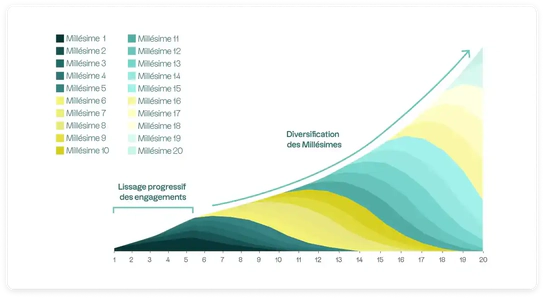
Private equity is based on the gradual deployment of capital, diversification across different investment rounds, and the creation of value over the long term. In this context, consistent capital allocation and investment discipline play a central role.
An educational analysis to better understand the unique characteristics of private equity compared to public markets.
The closed structure of private equity funds requires a long investment horizon, often between eight and twelve years. This timeframe facilitates the implementation of profound and consistent transformation plans.
The early years may be characterized by moderate performance, a phenomenon sometimes described as a J-curve. Value creation is realized primarily through divestitures.
This time-based discipline provides a structuring framework for investors capable of adopting a long-term wealth management long-term wealth management perspective.
The structural risks of private equity
Beyond investment motivations, private equity carries risks inherent to its nature.
There is a real risk of capital loss, as some companies may fail to meet their targets. Illiquidity limits management flexibility. The wide variation in performance makes stock selection critical. Strategies that incorporate leverage increase sensitivity to economic cycles.
Any decision to invest in private equity must be part of an overall analysis of assets, investment horizon, and risk tolerance.
Investing in private equity: a demanding allocation process
Investing in private equity is part of a long-term strategic asset allocation strategy. This asset class providesaccess to the unlisted economy,broadens portfolio diversification , and offers exposure to active corporate transformation strategies that are often uncorrelated with short-term fluctuations in public markets.
Private equity operates on a fundamentally different dynamic than publicly traded assets. Value creation does not depend solely on a favorable market environment, but rather on structured operational work carried out within the portfolio companies: process improvement, margin optimization, acceleration of organic growth, financial restructuring, or industry consolidation. This active approach is one of the hallmarks of private equity.
However, it is neither a one-size-fits-all solution nor an automatic source of returns. Private equity involves tying up capital for several years—sometimes more than a decade, depending on the strategy. This lack of liquidity requires careful planning and an allocation commensurate with the investor’s wealth profile.
It also requires a thorough selection of management teams, whose ability to deploy capital in a disciplined manner and to steer the transformation of portfolio companies is critical.
Furthermore, risk management in private equity relies on careful diversification: diversification across fund classes to smooth out exposure to economic cycles, diversification of strategies (buyout, growth, secondary, co-investment), and geographic and sector diversification . This methodical approach is a central pillar of the robustness of a private equity allocation.
When thoughtfully integrated into a coherent overall investment portfolio, private equity can serve as a key strategic tool for savvy investors seeking distinctive exposure to the growth of unlisted companies from a long-term wealth-building perspective.
With this in mind, investing in private equity is not a matter of opportunism, but rather a demanding, disciplined approach that is fully integrated into an overall allocation strategy.
FAQ – Investing in Private Equity
Why invest in Private Equity?
Investing in private equity can provide access to unlisted companies, diversify long-term allocations, and participate in transformation strategies, subject to accepting illiquidity and capital risk.
Does private equity offer a guaranteed illiquidity premium?
No. The illiquidity premium is theoretical and depends on many factors, including the quality of the investments, the vintage, and economic conditions.
What are the main risks of private equity?
The main risks are capital loss, illiquidity, performance dispersion among managers, and sensitivity to economic cycles.
How long should the investment period be?
A private equity fund generally has a duration of between eight and twelve years, with an initial investment phase followed by a divestment phase.
Is private equity suitable for all investors?
No. Its inclusion depends on the risk profile, the ability to tie up capital, and wealth management objectives.
Salma Moumen is Chief Project Officer at Altaroc. A graduate of TBS Education with a specialization in Banking & Corporate Finance, she began her career by assisting fintech companies with their fundraising efforts before focusing on the digital transformation of financial sector players, at the intersection of business and technology challenges. Through her articles, she offers an informative, well-researched, and objective analysis of private markets, their mechanisms, and the risks associated with them.
In accordance with applicable regulations, we ask that you complete your profile. This step is required to access the content and services offered on our websites.
Please fill out your profile to access the site
country of tax residence
Select
choosenCountry
Preferred language
Select
choosenLang
YOUR INVESTOR PROFILE
Financial intermediary or professional investor
Financial advisors, wealth managers, private bankers, or any other investment service providers.
Qualified Investor or Altaroc Investor
Experienced investor or Altaroc investor
Private investors who have already invested with Altaroc or who have a minimum investment capacity of €100,000.
Private investors who have previously invested in Altaroc who have a minimum investment capacity of 200,000 euros.
Non-professional (retail) investor
Individual investors with an investment capacity below €100,000.
Retail investors with an investment capacity of less than 200,000 euros.
Institutional investor
Pension funds, retirement schemes, asset management companies, and single-family offices.
Important information
choosenTerms
choosenTermsValue
Select your language and investor profile to continue
Select your investor profile to continue
Scroll down to accept General Terms and Conditions

_11zon.webp)



.webp)


.webp)


.webp)
.webp)