Circular Economy: Back Market Celebrates Its 10th Anniversary at the Church of the Holy Trinity in Paris
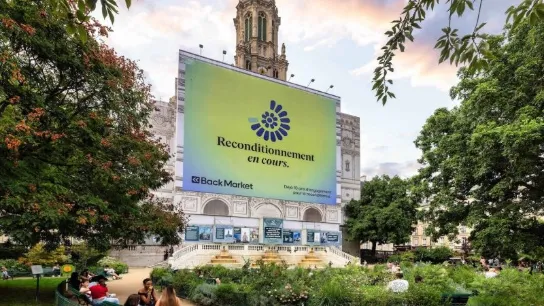
To mark its 10th anniversary, Back Market unveiled a unique advertisement on the historic Church of the Holy Trinity in Paris, which is currently undergoing renovation. The brand, which specializes in refurbished technology, covered the building with 500 square meters of signage bearing a simple message: “Renovation in progress.” A loading icon, inspired by the church’s rose window, symbolizes circularity—a nod to the company’s commitment to sustainability.
Thibaud Hug de Larauze, Vianney Vaute, and Quentin Le Brouster founded Back Market in 2014: an online platform dedicated to the sale of refurbished electronic devices. Their goal is to offer a reliable alternative to new products in a context of excessive technology consumption.
The Boom in the Refurbished Market in France
This model enabled the company to experience rapid growth, expanding into Europe, the United States, and other international markets. By 2022, the company was already valued at more than 5 billion euros, achieving “unicorn” status (a young, privately held technology company valued at more than $1 billion).
Over the past decade, Back Market has ridden a veritable wave of change in France:
- A market worth over one billion euros: The refurbished goods sector in France has far surpassed the one-billion-euro mark in annual revenue.
- Double-digit growth: The market is growing by more than 10 to 15 percent annually, driven by consumers' desire for low prices and their environmental awareness.
- The King of Smartphones: In France, more than 20% of the cell phones sold each year are now refurbished models.
What is the actual environmental impact that has been avoided?
Beyond the economic aspect, the platform's growth has a measurable environmental impact. Buying a refurbished electronic device rather than a new one helps prevent significant environmental damage:
- Raw materials: Approximately 175 to 200 grams of raw materials (such as rare earth elements or precious metals) are conserved per unit.
- CO2 Emissions: A refurbished phone helps prevent the emission of nearly 50 kilograms of greenhouse gases during its manufacturing phase.
- Energy and Water: This also results in significant water and energy savings, since 80% of a digital device’s environmental impact occurs during its initial production in the factory.
Display Marketing: The Hallmark of French Unicorns
The practice of displaying event-related signage on historic monuments under construction or in the streets has become a powerful communication tool for tech giants seeking to make a lasting impression on the general public:
- Alan (online health insurance): The brand made a lasting impression by completely decorating subway stations and buses with its famous colorful animal mascots, projecting a friendly image that stands in stark contrast to that of traditional insurers.
- Swile (meal voucher cards): To raise awareness of its solution in office settings, Swile launched a series of humorous, large-scale poster campaigns in major business districts, directly targeting everyday habits at work.
- ManoMano (online DIY): The platform has repeatedly subverted the conventions of outdoor advertising with offbeat slogans focused on home improvement projects, placing ads on strategic buildings to catch the attention of passersby.
By setting up shop at the Holy Trinity Church, Back Market is putting itself in the spotlight in a unique way, while linking the concept of “renovating” a historic monument to the “refurbishment” of our everyday devices.
.webp)

.webp)