
IFS projects a 22% increase in recurring revenue and a 31% increase in cloud revenue by 2025
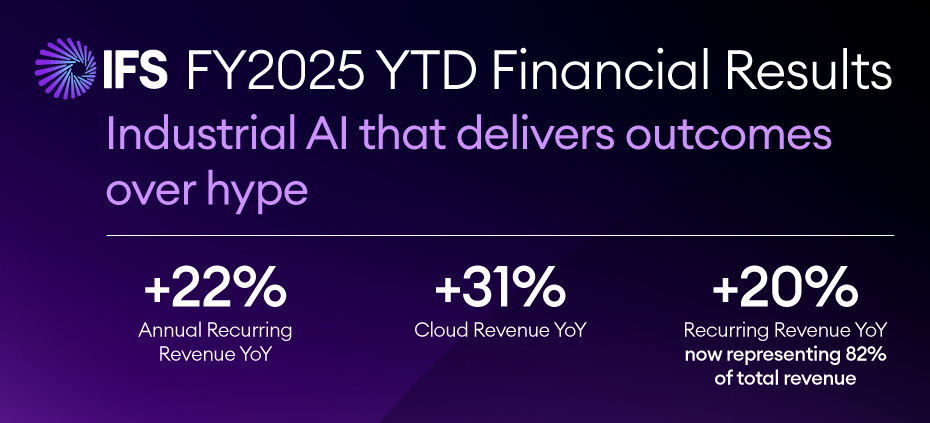
Swedish software company IFS, a specialist in management and maintenance software for large industrial companies, has just published its financial results for the first nine months of 2025. IFS reports continued profitable growth, confirming its central role in the sector's digital transformation. Its annual recurring revenue (ARR) jumped by 22% year-on-year, while cloud revenues increased by 31%, testifying to the massive adoption of its hosted solutions. Subscription-based revenues now account for 82% of total revenues, providing the Group with a solid, predictable base from which to finance its innovations.
This dynamic reflects a clear shift in the market: industrial companies are no longer simply experimenting with artificial intelligence, they are deploying it on a large scale in their most critical operations. IFS is capitalizing on this evolution with its IFS.ai platform, designed to address the operational complexity of large organizations: production, asset maintenance, logistics, field services. IFS customers include some of the world's largest corporations, such asArcelorMittal, TotalEnergies, Hitachi Energy, Japan Airlines, Callaway, as well as Aneo (Scandinavia's leading renewable energy company). These companies use IFS technologies to automate key processes, improve real-time decision-making and increase efficiency.
To put this trajectory into context, IFS’s growth has outpaced that of some of Europe’s largest software vendors over comparable periods. For example, German giant SAP reported a 25% increase in cloud revenue in the third quarter of 2024, while France’s Dassault Systèmes posted an 8% rise in software revenue over the same period. With 31% growth in the cloud segment, IFS is demonstrating remarkable agility and gaining critical market share in the enterprise asset management (EAM) and field service management (FSM) sectors.
The Real-World Impact of AI: Insights from the Field
In the field, the adoption of IFS.ai is yielding immediate operational gains. User feedback highlights a reduction in unplanned downtime and optimized supply chains. By combining predictive analytics with workflow management, manufacturers are seeing improvements in maintenance technician productivity of up to 20%, validating the value of natively integrating artificial intelligence into the core of business processes rather than simply as a technological overlay.
Outlook for 2026: The Era of Industrial Generative AI
By 2026, the evolution of the industrial ERP market will be driven by the maturity of generative AI. IFS is anticipating this transition by focusing its innovation cycles on contextual co-pilots capable of assisting operators using natural language, automating complex technical documentation, and simulating industrial maintenance scenarios. This strategy aims to transform raw data into an immediate driver of profitability for companies in the sector.
Founded in 1983 by five Swedish engineers, IFS began its adventure in an atypical way: its founders set up a tent in front of their first customer's site, so they could intervene at any time. Forty years on, this spirit of proximity and agility remains the hallmark of the company, which today employs over 7,000 people in 80 countries, and has reached a valuation of 15 billion euros.






.webp)