
This trend is not merely a passing fad. It reflects a profound transformation in the way investors build their portfolios and seek sources of long-term value creation.
At the same time, stock markets have remained one of the pillars of global investing. Liquid, transparent, and accessible, they allow investors to invest in thousands of publicly traded companies around the world.
Does this mean that private equity is a better asset class than publicly traded stocks? The answer is more nuanced.
Historical data published by Cambridge Associates, France Invest, and MSCI show that certain private equity strategies have historically generated annualized returns that exceed those of several major equity indices over long periods. But these results tellonly part of the story.
Comparing private equity to publicly traded stocks is not simply a matter of comparing two returns. It involves comparing two investment universes that differ in terms of holding period, liquidity, valuation methods, governance, and value creation mechanisms.
This article aims to analyze what twenty years of historical data actually reveal, the reasons behind the observed differences, and the methodological limitations that should be kept in mind before making any comparisons.
Why don't institutional investors view private equity and publicly traded stocks as mutually exclusive anymore?
When a retail investor learns about private equity, they often ask a simple question: “Does private equity yield higher returns than the stock market?”
That's a fair question. However, it doesn't reflect the way institutional investors think.
For a pension fund, a university endowment, or an insurance company, the real challenge is not choosing between public and private markets. It lies in building a portfolio capable of meeting several objectives simultaneously: seeking returns, managing risk, diversifying sources of value creation, and financing very long-term commitments.
In other words, private equity is generally not viewed as a substitute for publicly traded stocks, but rather as a complementary component of a diversified asset allocation.
This logic explains why the world's largest investors continueto invest heavily in both sectors.
Two Different Ways to Invest in Business Growth
At first glance, publicly traded stocks and private equity share a common goal: to finance the growth of companies.
In both cases, the investor hopes to benefit from economic growth, improved corporate profitability, and the value created over time.
The difference lies in how this value creation is captured.
In listed markets, investors purchase shares whose prices fluctuate daily based on financial market expectations.
In private equity, investors indirectly participate in the financingof unlisted companies, which are typically supported for several years by a management firm that plays an active role in their development.
This fundamental difference explains why the performance of the two asset classes cannot be analyzed solely in terms of return.
Two Investment Philosophies
Listed markets offer a great deal of flexibility. Investors can adjust their positions on a daily basisbased on their expectations or market conditions.
Private equity operates on a very different model. Capital is committed for several years to give companies time to implement their growth strategy.
This liquidity constraint often poses a challenge for some investors. For others, particularly institutional investors with very long-term commitments, it is, on the contrary, a characteristic that aligns with their investment horizon.

What do twenty years of historical data actually reveal?
Comparisons between private equity and publicly traded stocks are regularly the subject of studies published by organizations such as Cambridge Associates, MSCI Private Capital, and France Invest.
These analyses show that, historically, certain private equity strategies have generated annualized returns that exceed those of several major stock indices over long periods.
This observation is well documented. However, it should be interpreted with caution.
What the Cambridge Associates studies show
Cambridge Associates' research isone of the most widely used sources of information by institutional investors.
For several decades, their US Private Equity Index & Benchmark Statistics has compared the performance of U.S. private equity funds with that of the major stock indices.
Historical Performance of U.S. Private Equity Compared to Public Markets (Cambridge Associates)
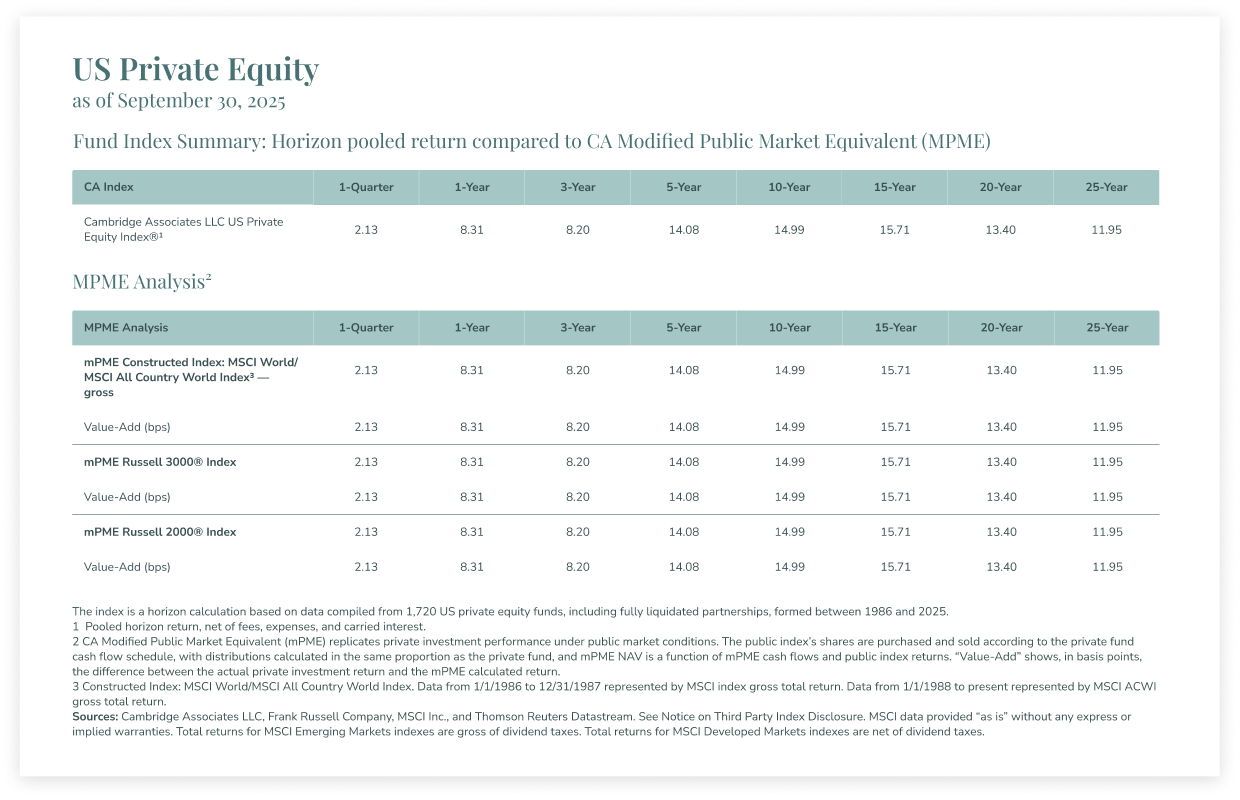
The various editions of this study consistently highlight the historical outperformance of buyout strategies over ten-, fifteen-, or twenty-year time horizons, depending on the periods examined and the methodologies used.
This historical outperformance partly explains why private markets now play a significant role in institutional asset allocations.
However, these results should not be interpreted as a guarantee of future performance. They reflect historical data that depends, among other factors, on the vintages studied, the strategies employed, and the economic conditions observed.
Why Numbers Don't Tell the Whole Story
Comparing two annualized returns is relatively simple.
Comparing two asset classes is much more complex.
Publicly traded companies are continuously valued by the market. Their stock prices instantly reflect investors' expectations.
In private equity, valuations are based on specific methodologies and are conducted at regular intervals in accordance with international standards such as the IPEV Guidelines.
In addition, private equity investors generally accept a longer investment horizon and lower liquidity than in public markets.
In other words, a meaningful comparison cannot be limited to a single column labeled “performance.” It must take into account all the characteristics specific to each investment universe.
Private Equity and Listed Stocks: A Comparison That Goes Beyond Returns
Before even analyzing the reasons behind private equity’s historical performance, it is worth noting that these two asset classes operate on different principles.
This comparison highlights a key fact: return is just one factor among many in the evaluation of an asset class.
For institutional investors, the way in which this performance is achieved, the level of risk accepted, and the role played in the overall portfolio construction are just as important.
Why has private equity historically created more value?
It is not enough to simply point out that, according to certain historical studies, private equity has outperformed public markets. The real question is: why?
Contrary to popular belief, this difference cannot be explained solely by the fact that these companies are not publicly traded. It stems from a set of mechanisms that characterize the very nature of private equity.
Research by Bain & Company, McKinsey, and Cambridge Associates shows that value creation in private equity generally relies on several complementary factors: operational support for companies, active governance, a longer investment horizon, and a particularly strong commitment to execution.
Value creation begins long before the company is sold
One of the main differences between a publicly traded investor and a private equity fund lies in the degree of their involvement.
In the financial markets, a shareholder buys a stake in a company that is already publicly traded. Even when a shareholder is convinced of the company's potential, their influence over strategic decisions is generally limited.
In private equity, the approach is different.
Management firms work alongside executives for several years to accelerate the company’s growth. They are often involved in major strategic decisions, such as international expansion, acquisitions, hiring key personnel, digital transformation, financial restructuring, and improving operational processes.
In other words, value creation does not depend solely on market trends. It also results from the changes implemented within the company.
According to Bain & Company, growth in operating income has historically been one of the main drivers of value creation in buyout transactions, ahead of the effects associated with changes in valuation multiples.

Private markets provide access to a portion of growth that has become inaccessible on the stock market
The global economy has undergone profound changes over the past twenty years.
In the 1990s, companies went public relatively early. As a result, a large portion of their growth was accessible to investors in the public markets.
Today, the situation is different.
Many companies remain privately held for much longer. They raise capital from venture capital, growth equity, or buyout funds before, in some cases, considering an initial public offering.
Companies such as Stripe, Databricks, and Canva have reached valuations in the tens of billions of dollars even though they were not yet publicly traded.
This trend has an important consequence: a significant portion of value creation now occurs before the initial public offering.
Private equity specifically providesaccess to this stage of development, which remains largely inaccessible to investors active solely in public markets.
More Active Governance
Companies backed by private equity funds often havea different governance structure than that of publicly traded companies.
Boards of directors are generally smaller, and communication between executives and investors is more frequent.
This proximity facilitates decision-making and allows for the faster implementation of certain strategic changes.
This is not to say that this approach to governance is inherently superior. It simply follows a different logic, one that is more focused on operational execution over a period of several years.
The Discipline of the Long Term
One of the paradoxes of private equity is that its main drawback— illiquidity—is also one of its strengths.
A fund is not intended to rebalance its portfolio on a daily basis.
Investments are made with a multi-year perspective in mind, which gives companies the time they need to carry out their development plans.
This approach naturally reduces the impact of daily fluctuations in the financial markets on strategic decisions.
It also allows the company to focus its efforts on creating fundamental value rather than on fluctuations in its stock price.
Why do institutional investors continue to increase their exposure to private equity?
While historical performance explains part of the interest in private equity, it is not enough to understand why this asset class now plays such an important role in institutional portfolios.
Professional investors rarely think in terms of pitting one asset class against another.
Above all, they seek to build portfolios capable of withstanding various economic conditions.
A Strategy of Diversification
Private equity provides exposure to companies, sectors, and business models that are not always represented in public markets.
For an institutional investor, this diversification can help limit reliance on a single source of returns.
This approach explains why private equity is generally used to complement listed stocks rather than as a substitute for them.
A vision consistent with very long-term commitments
Pension funds, insurance companies, and sovereign wealth funds often manage liabilities that span several decades.
In this context, tying up a portion of the portfolio for several years is not necessarily a constraint.
On the contrary, this characteristic may be consistent with their investment objectives.
This is one of the main reasons why institutions such as CPP Investments in Canada, GIC in Singapore, and major U.S. university endowments allocate a significant portion of their assets to private markets.
_2_11zon.webp)



.webp)
%20(1).webp)


.webp)
.webp)
.webp)