What returns can be expected from private equity over the long term?
Published on
21
Amended on
21
According to France Invest's 2023 annual study, French private equity has historically generated an average net internal rate of return (IRR) of 13.3% per year over a ten-year period.
Private Equity: How to Analyze the Risk-Return Profile?
The historical performance of private equity cannot be understood without taking into account the risks associated with it. Find out why illiquidity, manager selection, and investment horizon play a decisive role in analyzing the risk-return profile.
This article has been automatically translated. Please excuse any inaccuracies or translation errors.
Dieser Artikel wurde automatisch übersetzt. Bitte entschuldigen Sie etwaige Ungenauigkeiten oder Übersetzungsfehler.
This article has been automatically translated. We apologize per inaccuracies or translation errors.
By way of comparison, the CAC 40 posted an annualized return of about 7 to 8% over a comparable period. These figures explain why institutional investors—from pension funds to sovereign wealth funds—have gradually increased their exposure to private markets over the past two decades.
That said, what kind of returns can we really expect from private equity? The answer is more nuanced than a simple number.
The returns observed depend on many factors: investment strategy, the quality of the fund managers, the timing of the investment, the economic environment, and the holding period.
Above all, past performance is never a reliable indicator of future results.
This article analyzes historical data published by France Invest, Cambridge Associates, McKinsey, and other leading industry players to understand what private equity performance reveals over the long term.
It also explains why this asset class now plays a strategic role in institutional investors’ asset allocations and what the main factors are that influence observed returns.
Important
The data presented in this article is strictly historical and is provided for educational purposes only. It does not constitute a guarantee or a forecast of future performance. Any investment in private equity involves, among other things, the risk of capital loss and the risk of illiquidity.
What kind of returns can be expected from private equity?
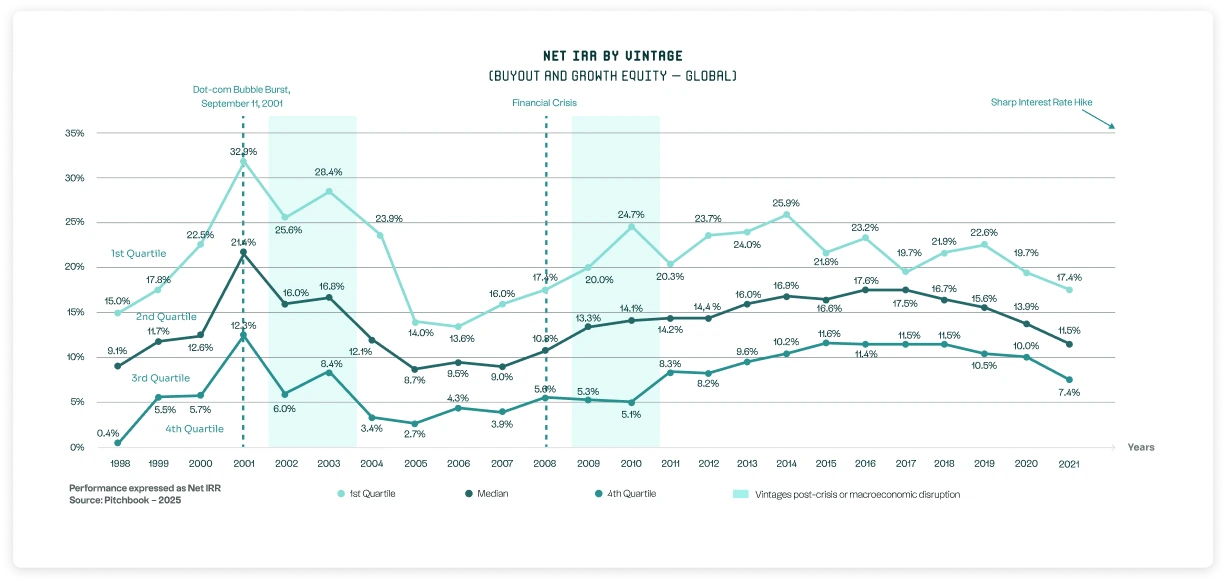
Historical data show that certain private equity strategies have generated IRR ranging from 10% to 15% per year over the long term, with top-quartile funds sometimes achieving even higher returns, according to Cambridge Associates, France Invest, and Pitchbook.
However, these results vary significantly depending on strategies, portfolio managers, investment periods, and market conditions. They are not a guarantee of future results.
Performance of Private Equity Funds by Quartile
Key Takeaways
Private equity returns are measured over the long term, generally ranging from eight to twelve years. They depend less on daily market fluctuations than on the ability of management firms to create value within the companies they support.
Why is the issue of returns so central to private equity?
When an investor considers allocating a portion of their portfolio to private equity, the first question that naturally comes to mind is the potential return. However, unlike publicly traded assets, performance cannot be analyzed in isolation from the investment horizon, liquidity, and the strategy employed.
Private equity involves providing financing to privately held companies with the aim of creating long-term value. Capital is typically tied up for eight to twelve years, during which time management firms support the companies’ growth prior to their sale.
This time frame explains why the performance metrics differ from those used in public markets.
Institutional investors are therefore not solely seeking high returns. They also evaluate private equity’s ability to diversify a portfolio, gain access to unlisted companies, and generate value drivers that are less dependent on day-to-day fluctuations in the financial markets.
An asset class designed to create value over time
Private equity is based on an industrial rather than a financial approach. After acquiring a company, private equity firms work with management to accelerate growth, strengthen governance, finance acquisitions, or improve operational efficiency. Value creation thus stems primarily from the gradual transformation of the company rather than from changes in the markets.
This approach explains why the average holding period for an investment is often between four and seven years, while the lifespan of a fund is generally ten years, with possible extensions depending on market conditions.
Expectations that differ from those of publicly traded markets
Unlike investors in publicly traded stocks, private equity investors do not track the daily fluctuations in the value of their investments. Companies are valued periodically, using recognized methodologies, rather than continuously as on the financial markets.
This unique characteristic alters perceptions of risk and performance. Institutional investors favor an analysis based on long-term value creation rather than short-term fluctuations. This approach helps explain why private equity now plays an increasingly important role in strategic asset allocations of many pension funds, insurance companies, and sovereign wealth funds.
What do the historical performance figures for private equity show?
The historical performance of private equity is regularly analyzed by leading organizations such as France Invest, Cambridge Associates, MSCI Private Capital, Bain & Company, and McKinsey & Company. Although their methodologies may vary, their research points to a common conclusion: certain private equity strategies have historically generated higher annualized returns than many traditional asset classes over long-term investment horizons.
This observation partly explains why institutional investors have gradually increased their allocation to private markets since the early 2000s.
However, this does not mean that private equity consistently outperforms public markets. Performance depends, in particular, on the investment strategy, the Fund manager, the fund’s launch year, and the economic environment.
Performance over a twenty-year period
In France, France Invest reports that private equity has historically generated an average IRR of 13.3% per year over a 20-year period. Internationally, Cambridge Associates also notes that U.S. buyout funds have historically outperformed several major equity indices on an annualized basis over comparable periods.
These results reflect value creation built over the long term through the growth of the companies we finance, rather than solely through changes in the financial markets.
Long-Term Performance of Private Equity
Asset Class
Historical Annualized Performance*
Horizon
French Private Equity (France Invest)
13,3 %
20 years
U.S. buyout (Cambridge Associates)
Historical outperformance relative to several major stock indices
20 years
CAC 40 (order of magnitude)
7 to 8%
Long-term
Global Stocks (MSCI World)
Varies by period
Long-term
The performance figures shown are based on historical data published by the organizations cited. They are neither a guarantee nor a forecast of future performance.
These comparisons help illustrate the historical potential of private equity, while also highlighting that private and public markets are based on different valuation mechanisms. Unlisted companies are not quoted daily, and their performance is evaluated over longer investment horizons.
Returns vary widely depending on private equity strategies
Private equity encompasses several market segments with distinct return profiles. It would therefore be an oversimplification to discuss private equity returns as a single figure.
Buyout funds, which invest in mature companies to accelerate their growth, have historically represented the largest segment of the market and delivered strong long-term performance.
In contrast, venture capital— which is dedicated tofinancing innovative startups—exhibits much greater variability. Some investments can generate significant valuation multiples, while others may result in a total loss of the capital invested.
Between these two approaches, growth equity, secondary market, and private infrastructure strategies serve different objectives, each with specific holding periods, risk profiles, and value creation drivers.
This diversity explains why institutional investors generally build diversified portfolios spread across multiple strategies, geographic regions, and investment horizons.
Why should historical performance be interpreted with caution?
Historical performance is a useful indicator for analyzing an asset class, but it cannot be interpreted without considering its context.
First, unlisted companies are valued periodically in accordance with recognized professional standards, unlike listed stocks, whose prices fluctuate constantly. This difference reduces the apparent volatility of portfolios without eliminating the underlying economic risk.
Second, performance indicators may vary from one study to another. Some publications present IRR , while others report IRR , multiples of invested capital (MOIC), or proprietary indices. Fees, currencies, investment universes, and the periods under review can also influence the results.
Finally, private equity is characterized by a wide dispersion of performance among fund managers. Data published by Preqin and Cambridge Associates show that funds in the top quartile have historically outperformed the least-performing funds by a wide margin. This dispersion is significantly greater than in public markets and underscores the importance of selecting the right management teams.
Key Takeaways
Historical data show that certain private equity strategies have generated attractive returns over the long term. However, these results depend on many factors, including the strategy chosen, the Fund manager , the investment year, and market conditions. Past performance is not indicative of future results.
Why has private equity historically generated high returns?
The historical performance of private equity is not driven by a single factor. It results from several mechanisms specific to private equity that distinguish it from public markets.
Studies published by McKinsey, Bain & Company, and Cambridge Associates regularly highlight specific drivers of value creation, based on supporting companies, a long-term investment horizon, and active involvement by asset management firms.
It is important to note, however, that while these mechanisms have historically contributed to the observed performance, there is no guarantee that they will produce the same results in the future.
The Illiquidity Premium
One of the key characteristics of private equity is its illiquidity. Unlike publicly traded stocks, which can be bought or sold daily on financial markets, a private equity investment typically involves a commitment spanning several years.
This tie-up of capital is often associated with what economists call an illiquidity premium. By agreeing to forgo immediate liquidity, investors can expect to be compensated for this constraint. This premium is one of the theoretical drivers of private equity’s historical performance .
However, it does not constitute an automatic return. Its magnitude depends, in particular, on the quality of the assets held, the investment strategy, and the managers’ ability to create value over the long term.
Operational value creation at the heart of the model
Unlike a public shareholder, who generally remains passive, private equity funds actively support the companies in which they invest.
Management teams work alongside executives toimprove operational performance,accelerate growth, finance strategic acquisitions, and strengthen corporate governance. This direct involvement is one of the key differences between private equity and public markets.
This long-term approach allows management companies to implement changes that can sometimes be difficult to carry out in an environment subject to the pressures of quarterly earnings.
Gaining access to companies that remain private for longer
The world of privately held companies has grown significantly over the past two decades.
Today, many companies choose to remain private for longer in order to finance their growth without being subject to the demands of the stock markets. A significant portion of value creation thus occurs before a potential initial public offering (IPO), or even without any plans for a public listing.
Private equity gives investors access to this universe of companies, which remains largely inaccessible through public markets. This exposure is one of the main reasons cited by institutional investors when they increase their allocation to private markets.
Alignment of Interests Between Investors and Fund Managers
The private equity industry generally operates on the basis of a strong alignment of interests between management firms and their investors.
Investment teams frequently invest a portion of their own capital in the funds they manage. Their variable compensation also depends, under certain conditions, on the long-term performance of the investments made.
This approach promotes a focus on creating sustainable value rather than pursuing short-term results. However, it does not guarantee performance and does not eliminate the risks associated with any private equity investment.
The Five Key Historical Drivers of Performance
Sector-specific analyses highlight five factors that have historically contributed to private equity performance:
Creating operational value through active support for businesses.
The illiquidity premium, which is linked to the tie-up of capital over several years.
Access to privately held companies, often prior to the key stages of value creation.
The alignment of interests among investors, executives, and management companies.
A long-term vision that allows companies to grow regardless of day-to-day market fluctuations.
Key Takeaways
The historical performance of private equity stems from a combination of complementary factors. It depends as much on the ability of managers to support companies as it does on the unique characteristics of private markets, such as the long investment horizon and illiquidity. None of these factors alone guarantees a specific level of future returns.
Why might two private equity investors achieve very different results?
Private equity is often portrayed as an asset class that delivers strong long-term returns. However, not all investors achieve the same results. Unlike public markets, where returns tend to track those of major indices, private equity is characterized by significant variation in performance across funds.
Studies by Cambridge Associates and Preqin show that the gap between the best-performing and worst-performing funds can be particularly wide: Within a single cohort, there can be an average spread of approximately 1,400 basis points between funds in the top and bottom quartiles. This heterogeneity explains why manager selection is one of the key drivers of performance in a private equity portfolio.
The quality of the fund managers is a key factor
The performance of a private equity fund depends first and foremost on the teams that manage it.
The best private equity managers typically possess in-depth industry expertise, a network that gives them access to attractive investment opportunities, and a proven ability to support management teams in growing their businesses. Their role extends far beyond simply providing capital; they contribute to strategy, governance, and the creation of operational value.
Conversely, a fund that benefits from a favorable market environment will not necessarily generate strong returns if the selection of companies or the support provided to them proves to be inadequate.
In private equity, the year a fund is launched—known as the "vintage"—plays an important role in its future performance.
Each investment class operates in a different economic environment. Company valuations, financing conditions, interest rates, and the level of competition among investors vary over the course of economic cycles.
A fund launched after a market correction will generally not invest under the same conditions as a fund established during a period of high valuations.
That is why institutional investors often seek to spread their investments over several years in order to limit their exposure to a single economic cycle. This strategy, known as vintage diversification, is one of the most common practices in building a private equity portfolio.
Diversification helps spread risk more effectively
Diversification is a fundamental principle of any long-term investment strategy. In private equity, it takes on a unique dimension due to the diversity of strategies and industry sectors.
Institutional investors generally build their portfolios based on several diversification strategies:
between different strategies (buyout, growth equity, venture capital, secondary market);
between several geographic areas;
between different economic sectors;
among several investment vintages;
among several management companies.
This approach does not eliminate the risk of capital loss, but it helps limit the impact that an adverse event could have on part of the portfolio.
Performance indicators must be analyzed as a whole
Comparing two funds based solely on their IRR lead to an incomplete analysis.
Professional investors rely on several complementary indicators to assess the quality of a private equity fund.
Performance indicators in private equity
Indicator
What it measures
IRR Internal Rate of Return)
Annualized return, taking all cash flows into account.
MOIC (Multiple on Invested Capital)
The multiple of capital generated relative to the amount invested.
DPI (Distributed to Paid-In)
Distributions actually paid out to investors.
TVPI Total Value to Paid-In)
Total value created, including dividends and equity interests still held.
Analyzing these indicators together provides a more comprehensive view of a fund's actual performance and helps avoid drawing conclusions based on a single figure.
Key Takeaways
Private equity performance depends on many factors, but the quality of the management teams has historically been one of the most decisive factors. Diversification across strategies, fund classes, and managers is also a key factor in building a more balanced portfolio over the long term.
Why doesn't past performance guarantee future results?
Historical performance is a valuable indicator for analyzing an asset class, but it can never be used to predict future returns. This rule applies to all investments, whether listed or unlisted.
Private equity is no exception to this principle. The results observed over the past twenty years reflect a specific economic, financial, and regulatory environment, which may change in the coming years. Investors must therefore analyze past performance with hindsight and consider it within its broader context.
Economic cycles are constantly changing
Like publicly traded markets, private markets go through cycles of expansion and slowdown.
Changes in interest rates, inflation, financing conditions, and corporate valuations directly influence investment opportunities and the terms under which funds are exited.
For example, an environment characterized by historically low interest rates has long favored buyout transactions by making it easier to finance acquisitions. Conversely, a rising interest rate environment can affect valuations, the cost of debt, and the pace of transactions.
Historical performance should therefore always be interpreted in the context of the economic cycle in which it was generated.
Market conditions influence returns
Beyond economic cycles, private equity performance also depends on numerous factors specific to each market.
Among the key factors that may influence returns are:
the valuation levels of companies at the time of investment;
the financing terms and the cost of credit;
the growth prospects for the relevant sectors;
the regulatory environment;
Exit terms, particularly in the context of industrial divestitures or initial public offerings.
These factors are constantly changing, which explains why the performance of the same type of fund can vary from one year to the next.
Private equity involves specific risks
Like any asset class, private equity involves risks that should be evaluated before making any investment decision.
The main risks of private equity
Risk
Description
Capital loss
The companies receiving funding may fail to meet their goals or experience operational difficulties.
Illiquidity
Capital is generally tied up for several years, and opportunities for early withdrawal remain limited.
Selection bias
Performance depends heavily on the quality of the investment management firms and the companies selected.
Macroeconomic Risk
Changes in interest rates, inflation, or economic conditions may affect valuations and exit terms.
These risks do not call into question the value of private equity as part of an asset allocation strategy, but they do justify an approach based on diversification, rigorous selection of managers, and an appropriate investment horizon.
A long-term approach remains essential
The very nature of private equity requires a long-term perspective.
Value creation generally takes place over several years, from the acquisition of a company through to its sale. The early years of a fund may be marked by capital calls and investments, before value creation gradually materializes.
That is why institutional investors favor a patient approach, based on a consistent and diversified portfolio allocation, rather than chasing short-term returns.
Key Takeaways
Historical performance data for private equity serves as a useful benchmark, but it does not predict future returns. Economic cycles, market conditions, the quality of fund managers, and risks specific to private markets directly influence results. A diversified approach and a long-term investment horizon remain essential principles.
What Institutional Investors Have Realized
Private equity's historical performance partly explains the growing interest in this asset class, but it is not the only reason for its success among institutional investors.
Large pension funds, sovereign wealth funds, insurance companies, and university endowments seek, above all, an asset allocation capable of creating long-term value while diversifying their sources of return. Private equity meets these objectives through its exposure to unlisted companies and performance drivers that differ from those of the financial markets.
Value creation in Private Equity
Contrary to popular belief, private equity performance does not rely solely on financial leverage or cost reduction. It stems primarily from actively supporting companies. This long-term approach aims to create
sustainable value before the company is sold. Watch the video featuring Frédéric Stolar, Managing PartnerAltaroc value creation in private equity
A position that has become strategic in institutional portfolios
Over the past twenty years, institutional investors have gradually increased their exposure to private markets.
Institutions such as the Yale University Endowment, CPP Investments in Canada, Temasek in Singapore, and numerous European pension funds now allocate a significant portion of their assets to private equity and other private assets.
This trend reflects a widely held belief: value creation is no longer limited to publicly traded companies. An increasing share of economic growth is now generated by companies that remain private for longer—or even throughout their entire development cycle.
Diversifying Performance Drivers
One of the main objectives of institutional investors is to build resilient portfolios capable of weathering various economic cycles.
From this perspective, private equity offers features that complement those of public markets:
exposure to unlisted companies;
drivers of operational value creation;
less dependence on daily fluctuations in the financial markets;
diversification of return sources within an overall asset allocation.
Private equity is not intended to replace publicly traded stocks or bonds. Rather, it serves as a complementary component of a long-term wealth management strategy.
An approach based on selection rather than the market
Unlike index-based investing, which is widely used in public markets, private equity relies primarily on the ability of management firms to identify, support, and grow value-creating companies.
Institutional investors therefore devote significant resources to selecting fund managers. In particular, they analyze:
their performance history;
the stability of the investment teams;
their sector-specific expertise;
their investment discipline;
their ability to support executives over the long term.
This selection is one of the key drivers of performance for a private equity portfolio and partly explains the differences observed among the various funds.
A coherent vision with a long-term investment horizon
The way private equity operates aligns with the objectives of investors who do not have an immediate need for liquidity.
Pension funds, university endowments, and insurance companies generally invest with a time horizon of several decades.
This perspective allows themto accept that their capital will be tied up in exchange for exposure to value-creation strategies that take time to yield results.
This long-term approach explains why private equity is now considered a strategic component of institutional asset allocations, alongside publicly traded stocks, bonds, and other private assets.
Key Takeaways
Institutional investors do not invest in private equity solely to seek potentially higher returns. They also seek diversification of performance drivers, access to unlisted companies, and a value-creation strategy tailored to a long-term investment horizon.
Key Takeaways on Long-Term Private Equity Returns
Data published by France Invest, Cambridge Associates, McKinsey, and MSCI Private Capital show that certain private equity strategies have historically generated attractive returns over the long term. This observation explains the growing role that private equity plays in institutional investors’ asset allocations.
However, the return on a private equity investment cannot be summed up by a single figure. Performance varies depending on the strategies employed, the quality of the management firms, the investment year, the economic environment, and the ability of the funded companies to create value.
Beyond its potential for returns, private equity is distinguished by an approach based on actively supporting companies, a long-term vision, and a diversification of value drivers. These characteristics make it an asset class that complements public markets, but one that is also more demanding in terms of manager selection and risk management.
Finally, it is important to remember that past performance is not indicative of future results. Like any investment, private equity involves, among other things, the risk of capital loss and illiquidity. An allocation tailored to the investor’s profile, combined with sufficient diversification and a consistent investment horizon, remains essential.
In summary
Historical returns in private equity reflect, above all, the ability to create value over the long term. Understanding the factors behind these returns is often more useful than trying to predict future returns.
FAQ on Private Equity Returns
What is the average return on private equity?
There is no single rate of return that applies to the private equity sector as a whole. Performance varies depending on strategies, managers, geographic regions, and investment time frames. In France, France Invest reports that private equity has historically generated an average IRR of 13.3% per year over a twenty-year period. These figures are based on historical data and do not constitute a guarantee or a forecast of future performance.
Is private equity more profitable than publicly traded stocks?
Some studies published by Cambridge Associates and France Invest show that private equity strategies—particularly buyout funds—have historically outperformed several major equity indices over 20-year time horizons. However, these comparisons should be interpreted with caution, as private and public markets differ in terms of liquidity, valuation methods, and investment horizons.
Why do performance results vary so much from one fund to another?
Private equity is characterized by a wide range of performance outcomes. Results depend, in particular, on the quality of the management firms, the companies selected, the investment year, the industry, and the economic environment. The selection of fund managers is therefore a key factor in a portfolio’s performance.
How long should you stay invested in private equity?
Private equity is an asset class designed for the long term. The typical lifespan of a fund is between eight and twelve years, although some strategies may extend beyond that. This time horizon allows management companies to support businesses in their growth before they are sold.
What are the main risks of private equity?
Like any investment, private equity involves risks. The main risks include the risk of capital loss, the risk of illiquidity, performance variation among fund managers, and risks related to economic conditions and company valuations. These risks call for a diversified approach and an appropriate investment horizon.
How do institutional investors evaluate a fund's performance?
Professional investors generally do not limit themselves to the internal rate of return (IRR) alone. They also analyze metrics such as MOIC, DPI, and TVPI, which help assess value creation, actual distributions, and the residual value of the portfolio.
Can past performance be used to estimate future returns?
No. Historical performance provides a useful benchmark for analyzing an asset class, but it does not predict future performance. Investment results depend, among other factors, on market conditions, the chosen strategy, the companies being invested in, and the quality of the management teams.
Important Information
The information presented in this article is provided solely for informational and educational purposes. It does not constitute investment advice, a personalized recommendation, or an offer to subscribe to a financial product.
The historical data cited is taken from publications by recognized organizations and is presented for illustrative purposes only. Past performance is not indicative of future results. Any investment in private equity involves, among other things, the risk of capital loss, illiquidity risk, and risks related to market conditions and the performance of the companies being financed.
Private Equity: How to Analyze the Risk-Return Profile?
The historical performance of private equity cannot be understood without taking into account the risks associated with it. Find out why illiquidity, manager selection, and investment horizon play a decisive role in analyzing the risk-return profile.
Salma Moumen is Chief Project Officer at Altaroc. A graduate of TBS Education with a specialization in Banking & Corporate Finance, she began her career by assisting fintech companies with their fundraising efforts before focusing on the digital transformation of financial sector players, at the intersection of business and technology challenges. Through her articles, she offers an informative, well-researched, and objective analysis of private markets, their mechanisms, and the risks associated with them.
How can we provide sustainable funding for organizations working to combat school dropout rates? This question was at the heart of the first edition of the Grand Forum de l’Éducation, organized on Thursday, October 15, at the Conservatoire national des arts et métiers in Paris by the AlphaOmega Foundation. While the funding needs of nonprofit organizations remain considerable, Maurice Tchenio, CEO ofAltaroc and president of the AlphaOmega Foundation, alongside Patrick Sapy, CEO of FAIR Finansol, advocated for an approach that has yet to be fully explored in France: leveraging private equity to bolster foundations’ resources and enable them to support nonprofit organizations over the long term.
Software adopted by every NFL team, AI agents that have already conducted 180 million interactions with patients, and a platform used by nearly one in five Fortune 500 companies. A look at nine acquisitions by the " Vintage "Odyssey over the past three months.
On October 15, 2026, the AlphaOmega Foundation will host the first edition of the Grand Forum on Education at the Conservatoire national des arts et métiers in Paris. This free one-day event will provide an opportunity to exchange perspectives, share experiences, and reflect together on a major challenge: enabling everyone to find their place in a world transformed by artificial intelligence.
Watch the full recording of the webinar “ Altaroc ” and learn how to build a sustainable private equity portfolio, inspired by the practices of institutional investors.
Check out the highlights from the “ Altaroc ” webinar, which focuses on how institutional investors build a sustainable private equity portfolio and support your clients’ wealth management strategies.
Private equity is playing an increasingly important role in the wealth management strategies of entrepreneurs and high-net-worth individuals. Pierre Ferron analyzes its role in asset allocation, wealth transfer, and long-term management.
Banking disintermediation diversifies corporate financing by tapping into private debt, private equity, bond investments, and crowdfunding, in addition to bank loans.
In accordance with applicable regulations, we ask that you complete your profile. This step is required to access the content and services offered on our websites.
Please fill out your profile to access the site
country of tax residence
Select
choosenCountry
Preferred language
Select
choosenLang
YOUR INVESTOR PROFILE
Financial intermediary or professional investor
Financial advisors, wealth managers, private bankers, or any other investment service providers.
Qualified Investor or Altaroc Investor
Experienced investor or Altaroc investor
Private investors who have already invested with Altaroc or who have a minimum investment capacity of €100,000.
Private investors who have previously invested in Altaroc who have a minimum investment capacity of 200,000 euros.
Non-professional (retail) investor
Individual investors with an investment capacity below €100,000.
Retail investors with an investment capacity of less than 200,000 euros.
Institutional investor
Pension funds, retirement schemes, asset management companies, and single-family offices.
Important information
choosenTerms
choosenTermsValue
Select your language and investor profile to continue
Select your investor profile to continue
Scroll down to accept General Terms and Conditions





_5_11zon.webp)



.webp)
%20(1).webp)
.webp)

.webp)
.webp)
.webp)
.webp)