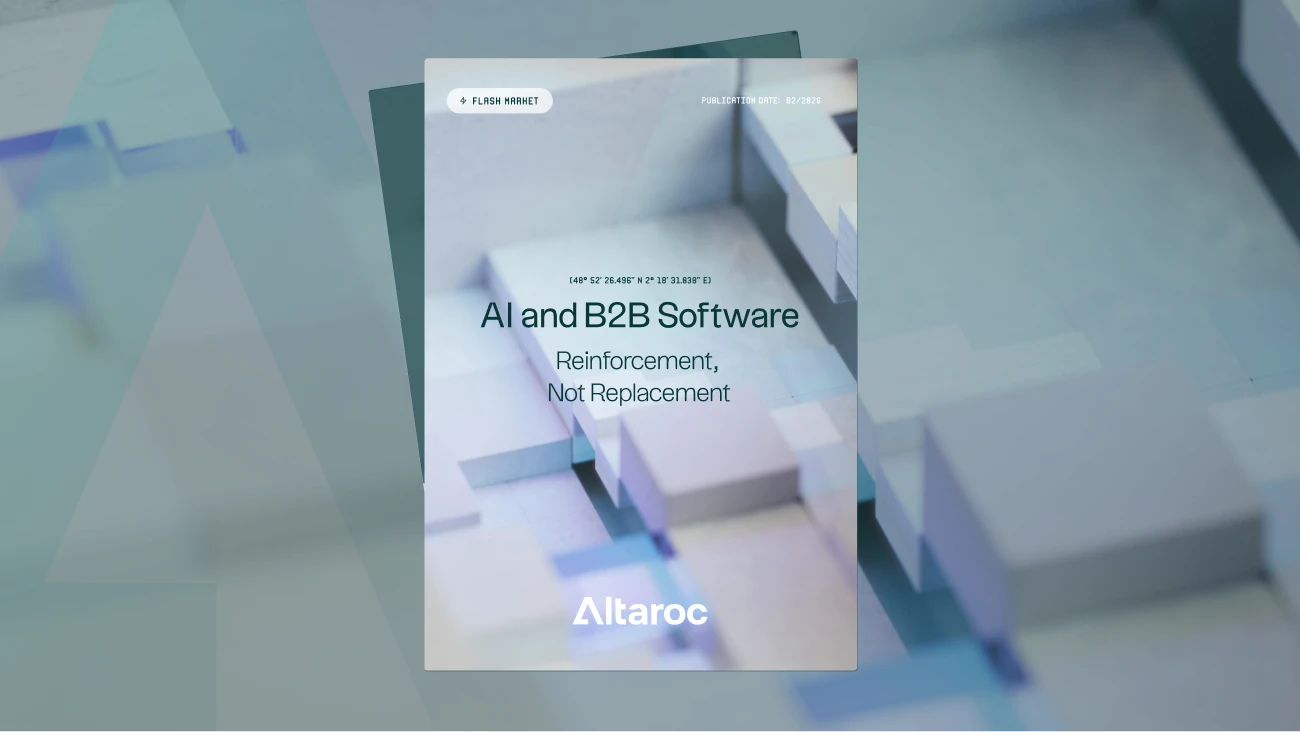

In this first issue, he looks at the software sector in private equity and how it has emerged as one of the strongest drivers in recent years.
What are the key points to remember from the document?
1. A strategic sector for private equity funds
- Historically funded by venture capital, the software sector is now a major asset class in LBO.
- The shift to the SaaS model has transformed the nature of revenues:
- Recurring subscriptions (ARR 85-95% of sales)
- High visibility and predictability of flows
- Taux de désabonnement faibles (<5 %)
- By 2024, the global SaaS market will exceed $200 billion, with a CAGR >15% (source: Gartner).
- The historical dependence on key talent (engineers, developers) is now largely under control thanks to professionalization and long-term incentives (shares, bonuses, DevOps culture).
2. Exceptionally strong economic fundamentals
- Scale effects: marginal costs are virtually nil once the software has been developed → EBITDA margins can reach 30-40%.
- Iso-customer growth :
- Upsell & Cross-sell: increased value per customer without additional acquisition costs.
- Pricing Power: price increase justified by the software's critical value.
- Key indicator: the "Rule of 40" (Growth % + EBITDA margin %).
- The best publishers exceed 60 points, a sign of an optimal balance between growth and profitability.
3. A massive, resilient market
- Worldwide software spending multiplied by 7 in 20 years, to exceed $1,000 billion.
- Software now accounts for 60% of the volume and 58% of the total value of private equity tech deals (PitchBook 2024).
- Funds specializing in the sector posted a IRR of 28.3% between 2017 and 2019 (compared with 15% for the overall private equity sector).
- Resilience confirmed: even in a difficult macro context, demand remains strong and qualitative ("flight to quality").
4. Attractive valuations once again
- After the bubble of 2021, valuations normalized:
- 25-30x EBITDA for the best profitable publishers,
- 6-8x sales for companies not yet profitable.
- The post-2022 rebound offers an attractive entry point into a sector with strong structural growth.
5. Software funds: a clear competitive advantage
- Sector expertise and pattern recognition: precise targeting of the most promising sub-segments.
- Proven playbook :
- Operational optimization (sales, marketing, pricing, data)
- Buy & Build strategies to create sector champions
- Refocusing on more profitable products
- Expert in-house teams: data, AI, cybersecurity, FP&A, HR, ESG, etc.
→ These funds now operate like true SaaS publishers, but with a Private Equity approach.
6. Artificial Intelligence: a performance catalyst
- AI reinforces critical software (ERP, HR, finance, supply chain) rather than replacing it.
- Estimated gains: +5 to +12 EBITDA margin points over the next few years.
- AI-enabled editors benefit from :
- Increased barriers to entry (network effects & proprietary data)
- Enhanced perceived value for customers.
- Only software with little differentiation (marketing, reporting, basic BI) risks disruption.
7. Prospects for structural growth
- Transition to the cloud still incomplete: only 36% of workloads hosted (target 53% by 2026).
- Global technical debt: $1.5 trillion → opportunity to modernize and migrate to SaaS.
- SaaS + AI: the combined growth and value driver.
- The software sector now attracts $200 billion in "dry powder" (uninvested funds raised).
8. Conclusion - A lasting opportunity for investors
- Sector with structural growth, recurring revenues, high profitability.
- Fueled by digital transformation and AI, it combines:
- Visibility of cash flows,
- The power of scale effects,
- Consolidation potential through Buy & Build.
- SaaS publishers remain premium private equity targets - a strategic pillar in long-term portfolios.
Detailed analysis here





.webp)
.webp)



.webp)