80 Acres Farms Speaks Out on the Global Food Transition at the UN
Through its Director of Operations, Noah Zelkind, 80 Acres Farms found itself in the spotlight at UN headquarters in New York. A few days ago, the UN organized a presentation there featuring student projects from several countries (Thailand, Singapore, the United States, and others). The origins of the American company’s presentation lie in a project by two U.S. students, Jack and Thomas, seniors at Butler Tech Ross High School in Ohio. For years, the two friends have worked closely with several local stores and producers to ensure that unused fresh produce is donated to people in need.
“The team at 80 Acres Farms was truly among the first to see something greater in us than what we ourselves had envisioned,” said one of the two high school students. They met with Noah Zelkind several times to discuss the development of their global supply chain, which now provides fresh food to people in need through more than 100 partner organizations across the United States and South Korea.
Noah Zelkind endorsed Jack and Thomas’s project, then took advantage of the opportunity to introduce 80 Acres Farms, which now sells its products throughout the United States. This spotlight provided an opportunity to discuss the growing barriers facing traditional agriculture, which is struggling to keep pace with global demographic changes. “Our existing food systems simply cannot meet the needs of the future and our ever-changing world,” he said.
The Global Demographic Challenge and the Urgency of the AgTech Transition
80 Acres Farms’ presentation to the United Nations echoes alarming population projections. By 2050, the world’s population is expected to approach 10 billion people, requiring a nearly 60% increase in global agricultural production, according to the UN. Faced with this surge in demand, traditional agriculture is grappling with the depletion of arable land and recurring climate crises.
To address this food crisis, the global vertical farming market is experiencing massive growth. Driven by the need to ensure national food security, this sector is attracting increasingly large amounts of capital, establishing itself as one of the most dynamic growth segments in technology and industrial private equity .
Productivity and Sustainability: A Comparative Analysis of Performance Indicators
One of the ideas being proposed is to shift our consumption patterns toward vertical farms, which can complete 2,500 growing cycles (from planting seeds to harvest) per year, compared to about 50 for conventional agriculture, while producing 300 times more per square meter. Farms like those operated by 80 Acres Farms provide fresh, healthy food grown without pesticides and using 95% less water than traditional farming methods. Growing crops in these indoor farms allows the food to be packaged immediately, drastically extending its shelf life.
The transition from a traditional horizontal farming model to 80 Acres Farms’ standardized indoor infrastructure is based on specific financial and environmental metrics:
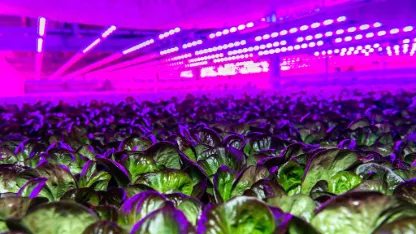
- Yield and Space Optimization: Traditional agriculture depends on the rhythm of the seasons and the vagaries of the weather. By stacking crops under fully automated LED lighting, vertical farms are no longer at the mercy of the weather. They make it possible to increase the number of continuous production cycles in a drastically reduced floor space, thereby preventing deforestation and land development.
- Water Resource Management: While open-field agriculture consumes nearly 70% of the world’s freshwater reserves through often inefficient irrigation, Infinite Acres’ closed-loop hydroponic systems recycle ambient moisture. Plant transpiration is captured, filtered, and then recirculated, resulting in a 95% water savings per kilogram of produce.
- Financial Structure (CapEx vs. OpEx): Building vertical farms requires massive initial investments (CapEx) in automation and thermal infrastructure. However, the traditional model remains heavily exposed to the volatility of operating expenses (OpEx): the cost of chemical fertilizers and pesticides, as well as costly long-distance logistics. 80 Acres Farms mitigates these operational risks, guaranteeing distributors fixed volumes and stable prices throughout the year.



.webp)
.webp)
.webp)