80 Acres Farms is building a $120 million mega-farm in Georgia to expand its national network
"This plant aims to 'meet consumer demand for fresh, locally grown products, combat food insecurity, and ensure a healthier and more sustainable food supply,'" according to the municipality's press release. The investment will also create 150 new jobs.
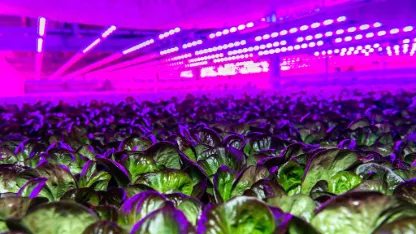
A pioneer in sustainable agriculture, 80 Acres Farms operates “highly efficient vertical farms” that produce up to 300 times more than traditional agriculture on an equivalent area. These “new” farms use 95% less water and minimize food waste and delivery distances—a true ESG achievement!
Financial details and the location of Covington's infrastructure
This expansion beyond its home region in the Midwest is taking shape in the heart of Newton County, in Covington, Georgia. The project represents a capital investment of $120 million to build a next-generation production facility. Fully optimized for controlled-environment agriculture (CEA), this automated mega-farm is designed to produce, at full capacity, four times the volume of produce as the historic Hamilton, Ohio, facility.
For the City of Covington and the State of Georgia, this project is a top priority for regional economic development. The 150 jobs created span a wide range of skill sets, from robotic systems operators to agricultural data analysts, bringing a high-tech dynamic to the state’s leading industry: agriculture.
“Our first next-generation production farm outside the Midwest is being established in the heart of Georgia. We were looking for a community where public officials and business leaders prioritized the future of agriculture, and we found that in Covington,” said Mike Zelkind, CEO and co-founder of 80 Acres Farms.
Deployment Schedule and Market Integration
- Construction and Structuring Phase: The industrial fit-out of the building and the integration of the automated vertical farming systems across 10 levels were completed by the end of the summer.
- Launch and Distribution Phase: The first harvests of tomatoes, herbs, and microgreens began being delivered to major retailers in the Atlanta area in early 2023.
Comparative Analysis: Operational Viability in the Face of AgTech Pivots
The launch of this website comes at a time when the vertical farming market is undergoing a major restructuring, characterized by a rigorous selection of the most resilient models. While some competitors in the sector have suffered operational setbacks due to energy-intensive cost structures or poorly implemented technologies, 80 Acres Farms’ strategy stands out:
- Technological synergy: Drawing on its subsidiary Loop (Infinite Acres) and leading technology partnerships (Siemens), the company has scaled up its thermal management and nutrient distribution software.
- Crop diversification: Unlike indoor farms limited to the exclusive production of low-value-added lettuce, the Covington facility has the capacity to grow fruits (small berries) and fruit vegetables (tomatoes and mini-cucumbers) on a continuous basis, enabling it to command higher margins from distributors.
- Capital Expenditures (CapEx): The $250 million raised by the company was directed specifically toward automating internal logistics processes, drastically reducing labor costs per kilogram of packaged product.
Quantified environmental and ESG indicators
The Covington plant exemplifies the application of strict environmental criteria at the heart of Scope 3 requirements for the retail sector. The complete absence of pesticides or chemical inputs eliminates the risk of soil contamination.
Recycling these streams results in clear impact metrics:
- 95% water savings: Thanks to industrial condensers that capture transpiration from the suspended plants, the water is purified, enriched with minerals, and recirculated into the hydroponic system. This closed-loop system prevents the water loss through evaporation that is inherent in traditional irrigation.
- Land-use optimization: By stacking crop areas vertically, a single industrial building can replace the equivalent of several dozen hectares of horizontal farmland, thereby limiting land conversion.
- Logistics Carbon Footprint: The facility’s location on the outskirts of Atlanta, near the city’s consumer market, eliminates the need for long-distance refrigerated transport (often transcontinental shipments from California or Mexico), reducing the CO2 footprint associated with the distribution supply chain by nearly 90%.



.webp)
.webp)
.webp)